



Get in touch

Shipping from China to Singapore: Complete Guide to Cost, Transit Time & Customs

Reliable Air Freight, Sea Freight, Express & DDP Shipping Solutions from China to Singapore with Competitive Rates and Professional Customs Support.

Get a Quote

Your one-stop shipping solution from China to Singapore

Discover tailored shipping solutions for every need, from China to the Singapore. Whether it's air, sea, express, or multimodal transport, our comprehensive services ensure efficient, cost-effective, and timely deliveries, simplifying your entire logistics process.

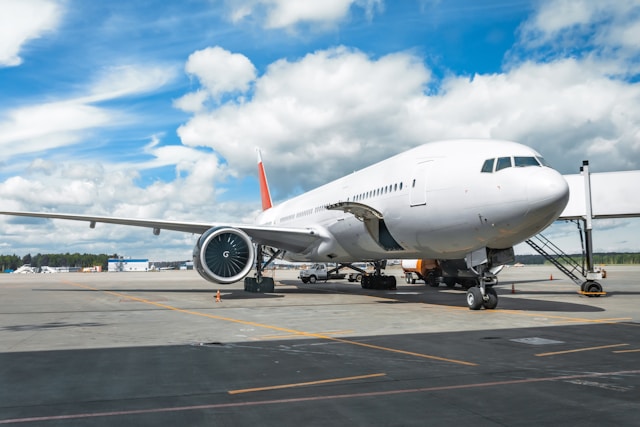
  • Air Freight from China to Singapore

    Ideal for urgent, high-value goods needing quick delivery AIRPORT TO AIRPORT, DOOR-TO-DOOR shipping from China to USA, 2-8 Working days delivery with carefully selected carriers

    Get Best Rates
  • Express Freight from China to Singapore

    Fast and efficient door-to-door Express Shipping Solutions from China to the USA for smaller, time-sensitive packages.Shipped by FedEx, UPS, DHL, DPD, 2-5 work days delivery time

    Get Best Rates
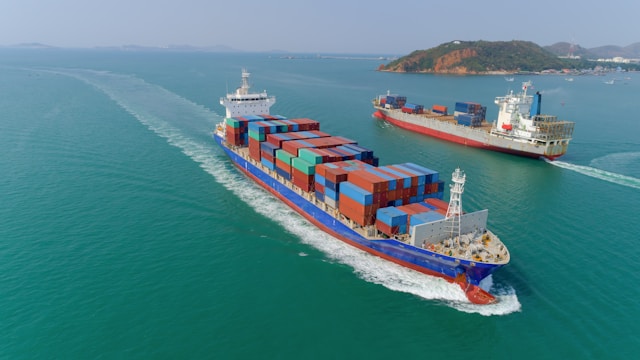
  • Sea Freight from China to Singapore

    Affordable and efficient for larger, bulk shipments with flexible options.FCL and LCL both available. Can by DOOR TO DOOR and PORT TO PORT services. 20-25days fast sea freight.

    Get Best Rates
  • Door to Door Shipping China to Singapore

    Affordable and efficient for larger, bulk shipments with flexible options.FCL and LCL both available. Can by DOOR TO DOOR and PORT TO PORT services. 20-25days fast sea freight.

    Get Best Rates
  • Shipping from Alibaba to Singapore

    Affordable and efficient for larger, bulk shipments with flexible options.FCL and LCL both available. Can by DOOR TO DOOR and PORT TO PORT services. 20-25days fast sea freight.

    Get Best Rates
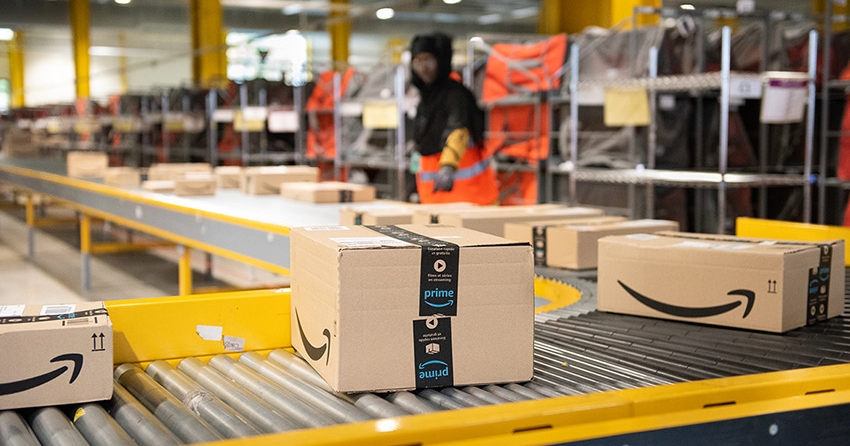
  • Shipping from China to Singapore Amazon

    Affordable and efficient for larger, bulk shipments with flexible options.FCL and LCL both available. Can by DOOR TO DOOR and PORT TO PORT services. 20-25days fast sea freight.

    Get Best Rates

    Your Best Freight Forwarder from China to Singapore

Contact now

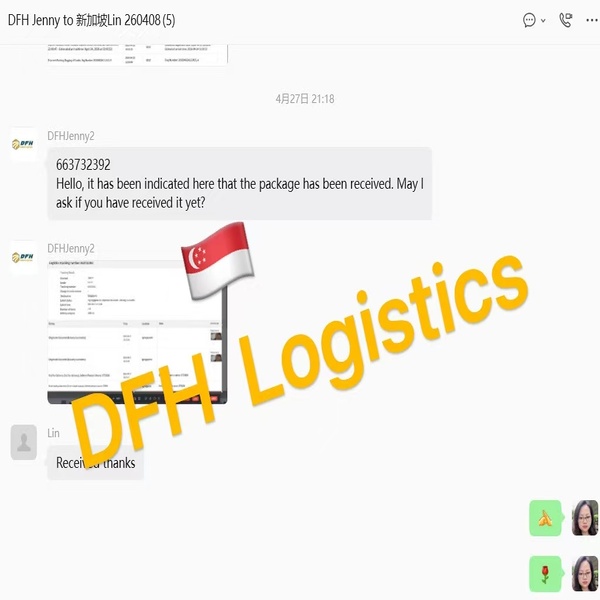
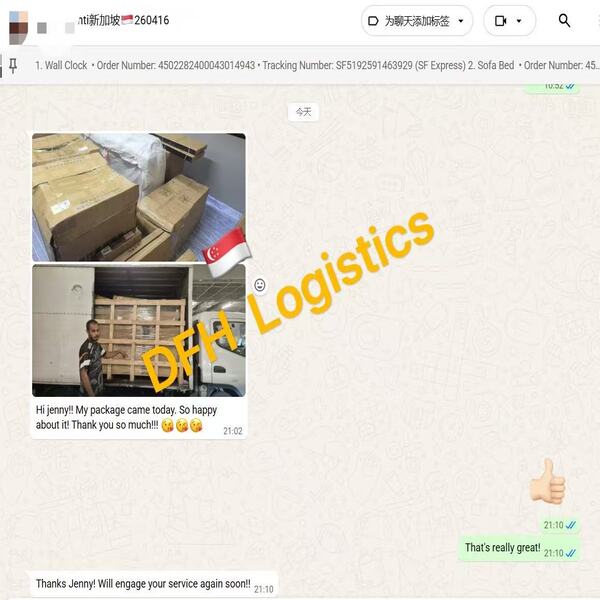
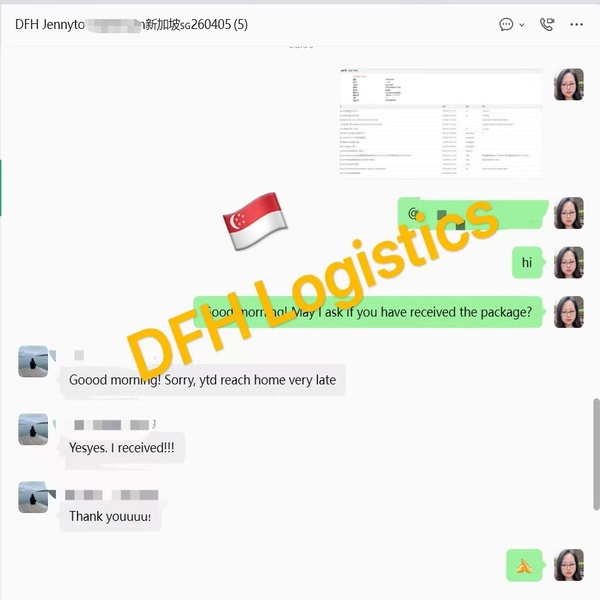
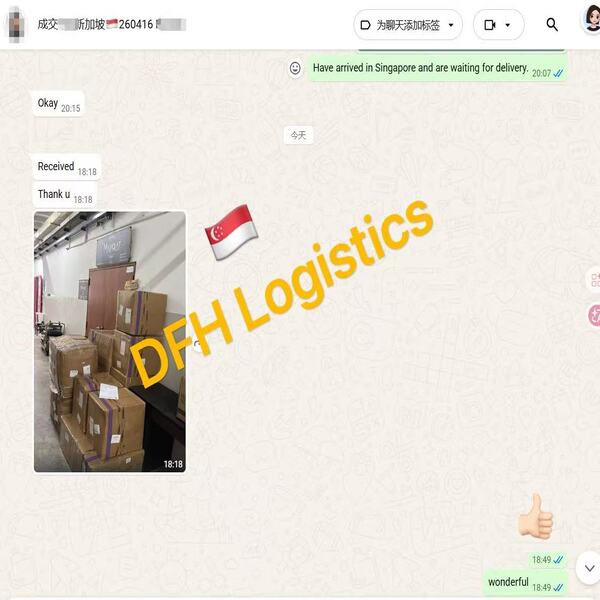
What Our Clients Say

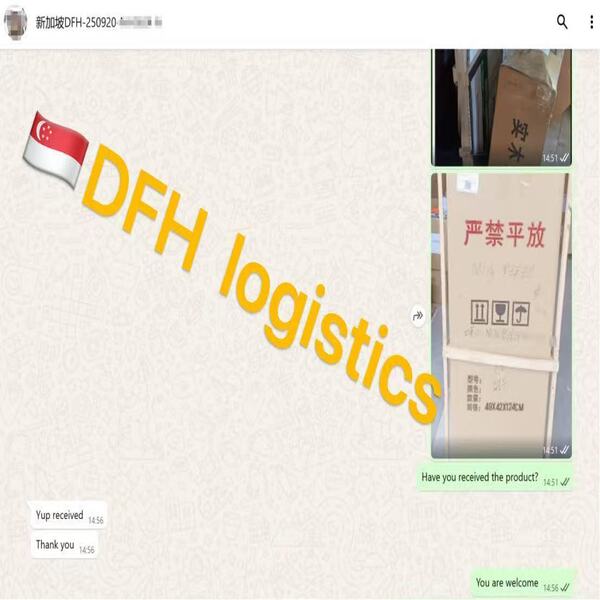
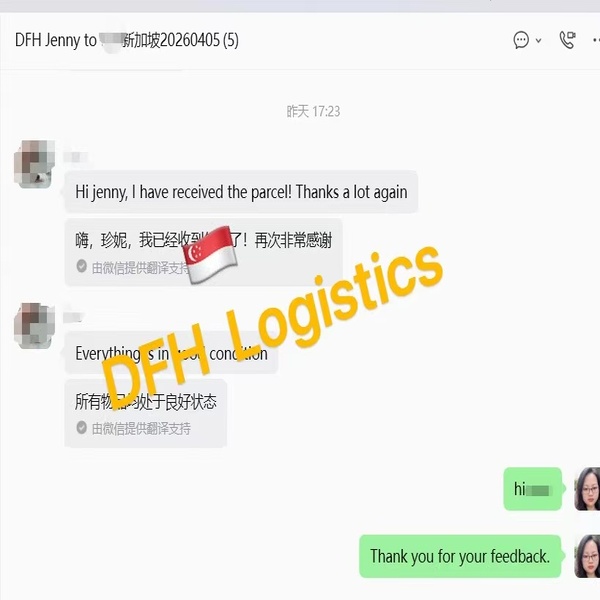
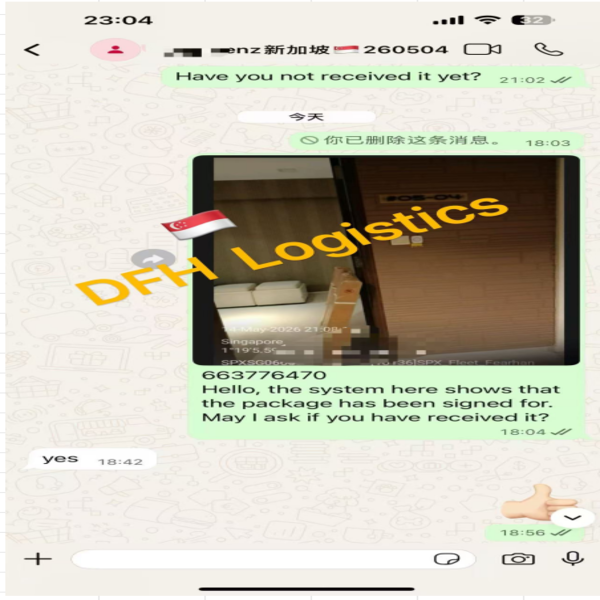
DFH’s services have simplified logistics, earning trust and referrals from our clients.

Get a free quoe

How Our China to Singapore Shipping Process Works

  • Step 1

    Pick-Up in China
    We’ll arrange pick-up directly from your supplier in China.

  • Step 2

    Freight Preparation
    DFH handles all packaging, labeling, and weight confirmation.

  • Step 3

    Documentation & Customs
    Our team completes all export and import documents for smooth customs clearance.

  • Step 6

    Final Delivery
    Get door-to-door delivery or pick up locally, based on your preference.

  • Step 5

    Singapore Customs Clearance
    We manage import customs, duties, and taxes when goods arrive in the Singapore.

  • Step 4

    International Transit
    Choose the best shipping solution based on your time and budget needs.

Shipping from China to Singapore: Complete Guide to Cost, Transit Time & Customs

Singapore is one of the biggest logistics hubs in Southeast Asia. When shipping from China to Singapore, importers don’t need to worry about flight or vessel schedule. However, they struggle with unpredictable total landed cost, customs clearance issues, and goods consolidation of multiple suppliers. In this guide, I will tell you everything you need to know about shipping from China to Singapore, including freight cost, transit time, the best shipping method, customs clearance, GST, and risks with corresponding tips.

How to Ship from China to Singapore?
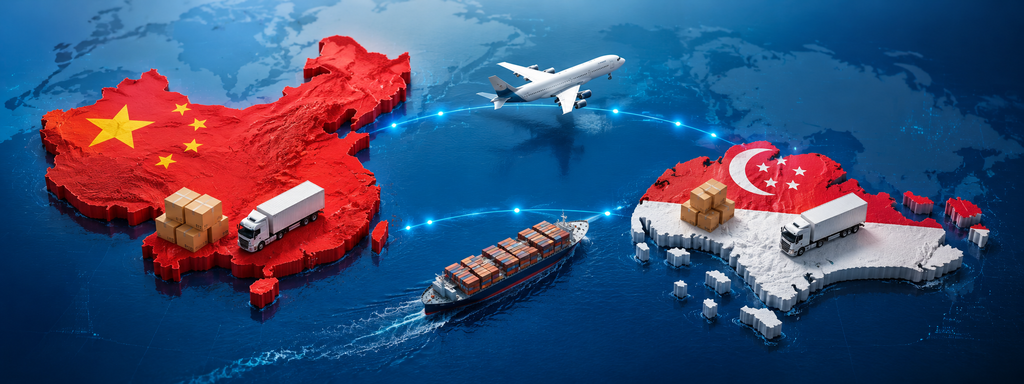
China to Singapore Shipping Solutions

Importers can ship from China to Singapore by working with a China-based freight forwarder, supplier arranging the shipment directly and using a Singapore-based freight forwarder. These three options have their own advantages and disadvantages, and each option is suitable for different situations. Let’s make a comparison of them.

OptionProsConsSuitable for
China-based Freight Forwarder– Best coordination in origin side, especially when you have multiple suppliers.
– Logistics specialist: can provide flexible shipping routes with competitive price.
– Support customized service.
– Fast updates on shipment status and timely feedback.
Service quality varies among freight forwarders.Importers who have more than one supplier and who want to reduce total landed cost.
Supplier Arrange the Shipment– Simple and convenient.
– No need to find a freight forwarder by yourself.
– Nontransparent shipping cost.
– Limited shipping methods.
– If you have multiple suppliers, shipping separately is expensive.
– Limited control over shipment for importers.
First-time importers and sample shipment.
Singapore-based Freight Forwarder– Easier communication with local service providers.
– Better understanding of Singapore import regulations and customs requirements.
– Good local support.
– Less control over the China side.
– May need a agent in China to handle the consolidation and logistics.
– Higher shipping cost.
Importers that prefer working with local logistics providers.

So, no matter you are a first-time importer or established business, it’s highly recommended to choose a professional China-based freight forwarder who can provide customized logistics solutions with the most competitive price.

What Is the Best Shipping Method from China to Singapore?

The best shipping method from China to Singapore depends on your specific situation. Importers need to consider their cargo type, budget, and required service. The main shipping methods from China to Singapore include air freight, express, sea freight and DDP shipping.

Air Freight from China to Singapore
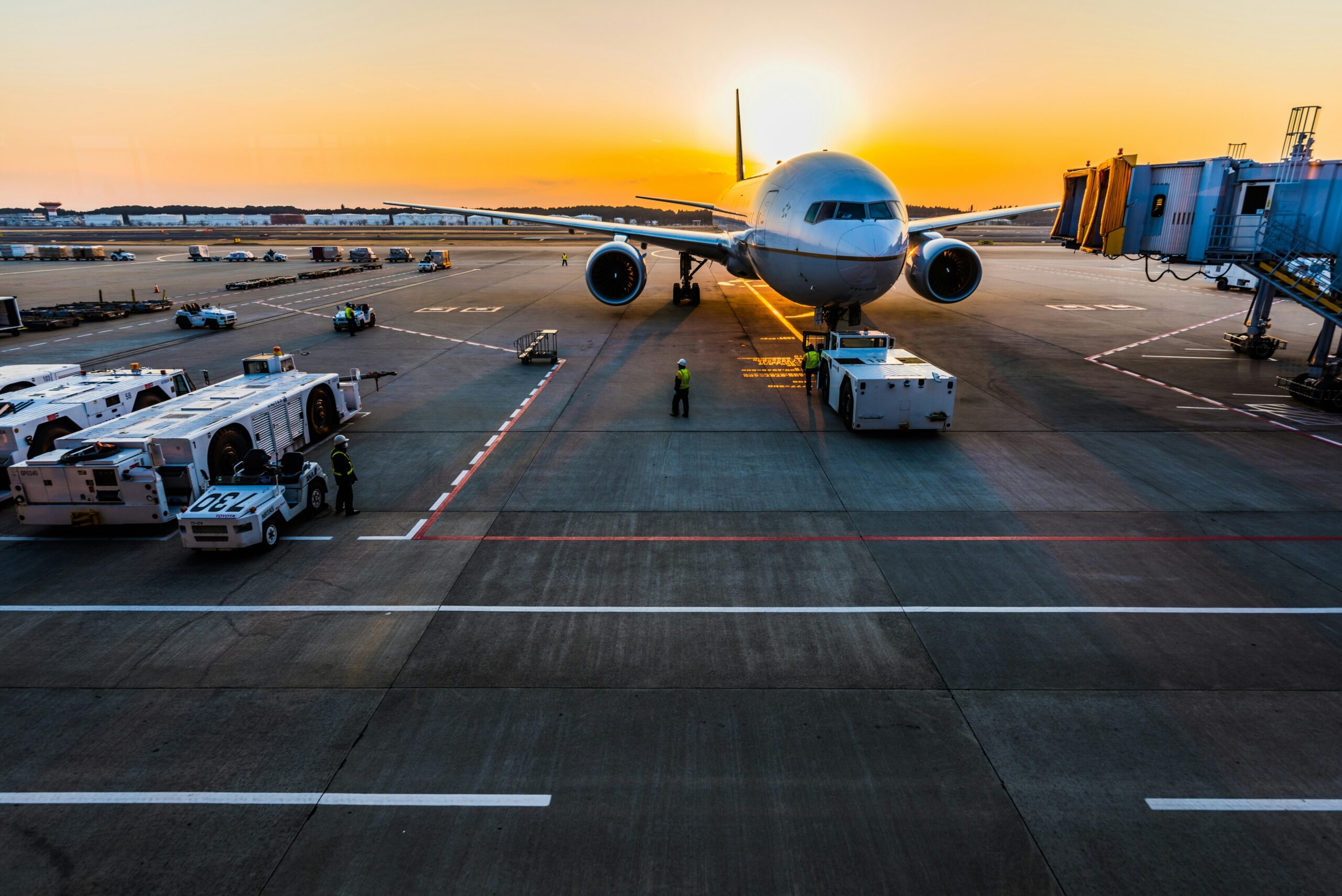
Air Freight from China to Singapore

Air freight allows importers to enjoy fast transit times and flexible flight schedules. It’s suitable for time-sensitive shipment and high-value cargo shipping. Air freight is much safer than sea freight due to a shorter shipping time, but it is more expensive than sea freight.

Sea Freight from China to Singapore
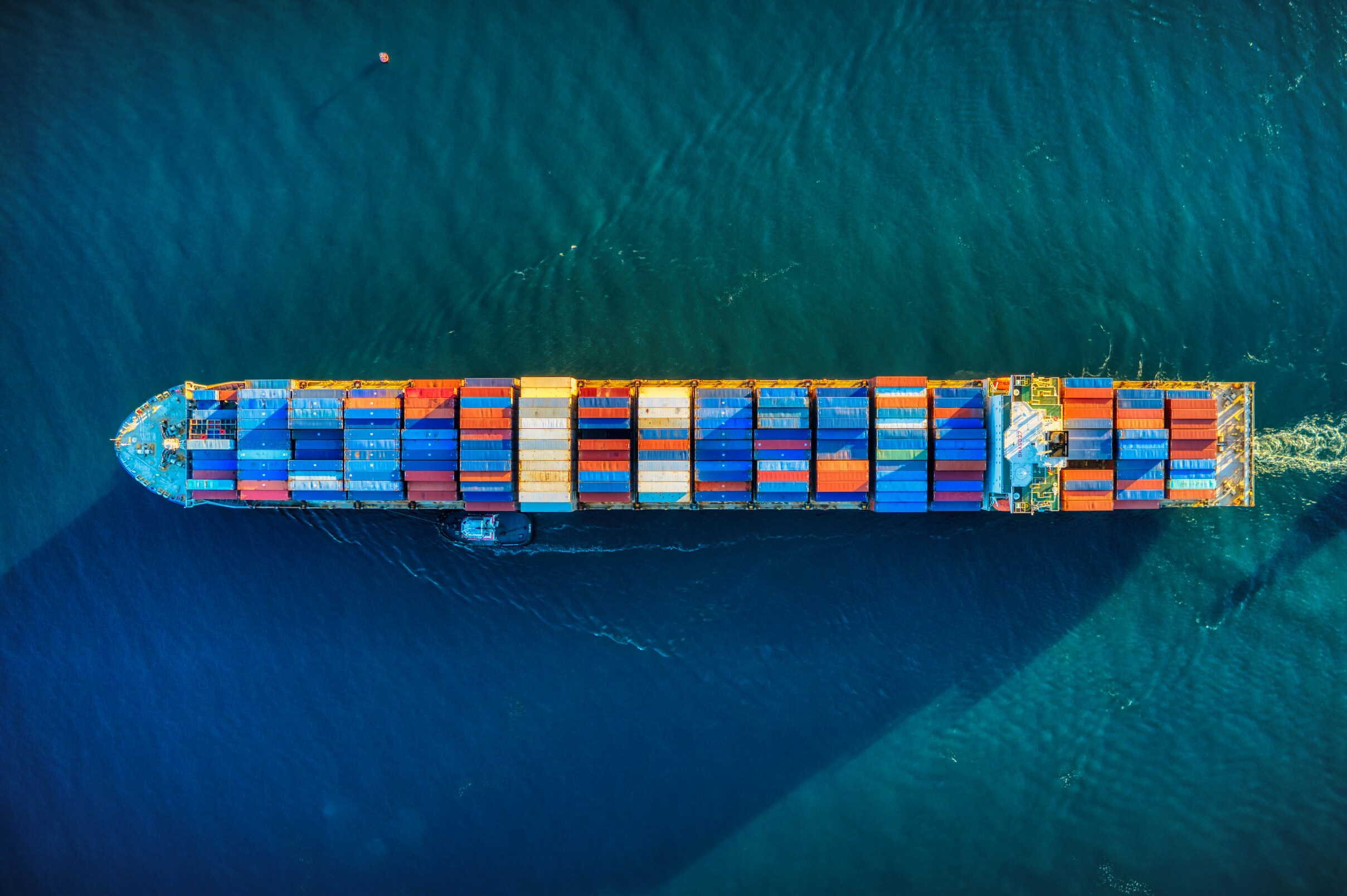
sea freight from China to Singapore

Sea freight is the most cost effective way to ship from China to Singapore, but it has the longest transit time. It’s very suitable for bulk shipment, oversized cargo and special goods shipping. Sea freight provides FCL(Full Container Load) and LCL(Less than Container Load) for options.

Express Freight from China to Singapore
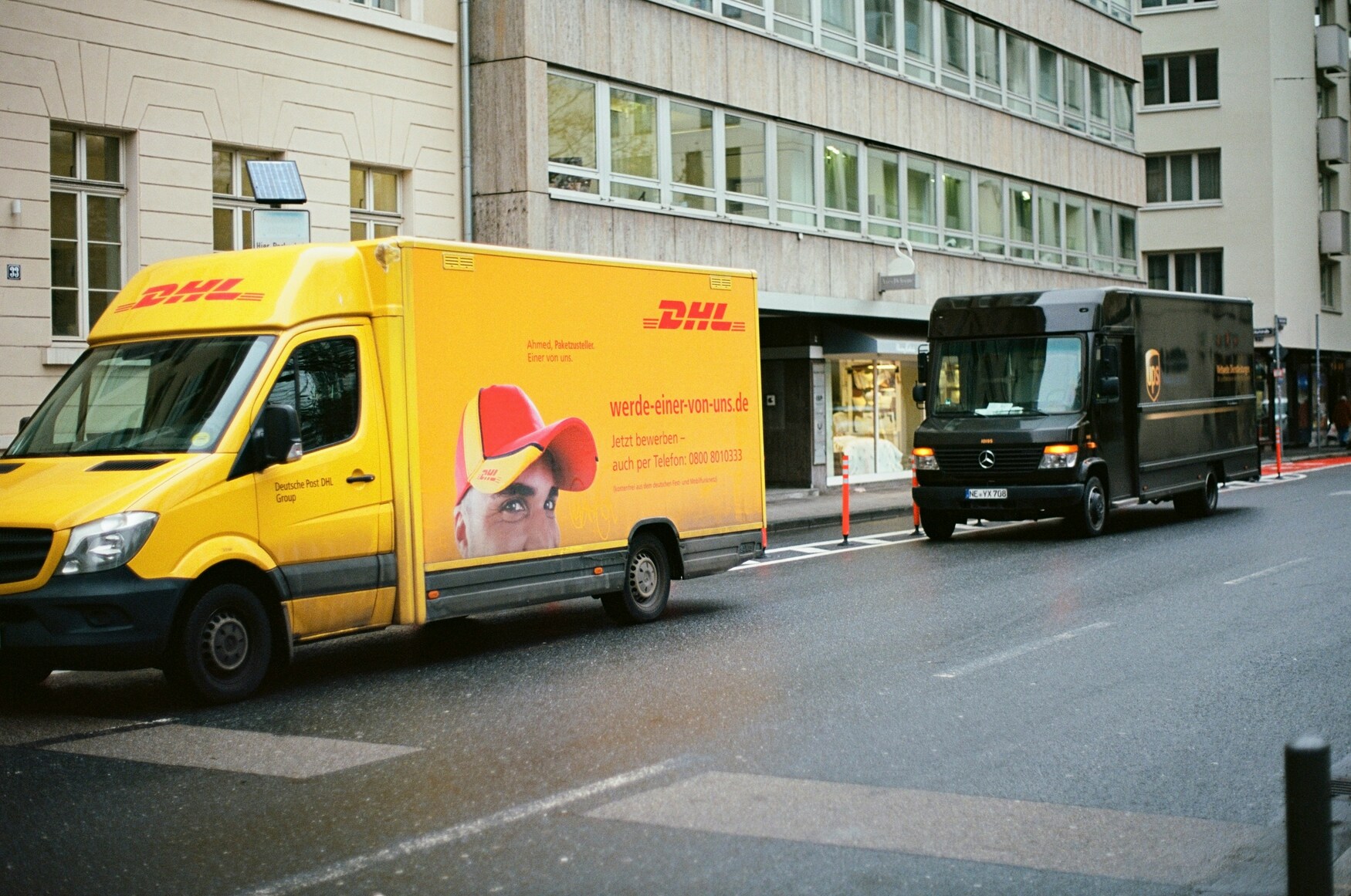
Express Freight from China to Singapore

Express freight is the fastest way to ship from China to Singapore, but it’s more expensive than sea freight. Compared with standard air freight, express freight handled by couriers like DHL, FedEx, and UPS has very strict regulations on cargo type, dimension and weight. It’s suitable for sample shipment, urgent files, and small time-sensitive parcel.

DDP Shipping from China to Singapore
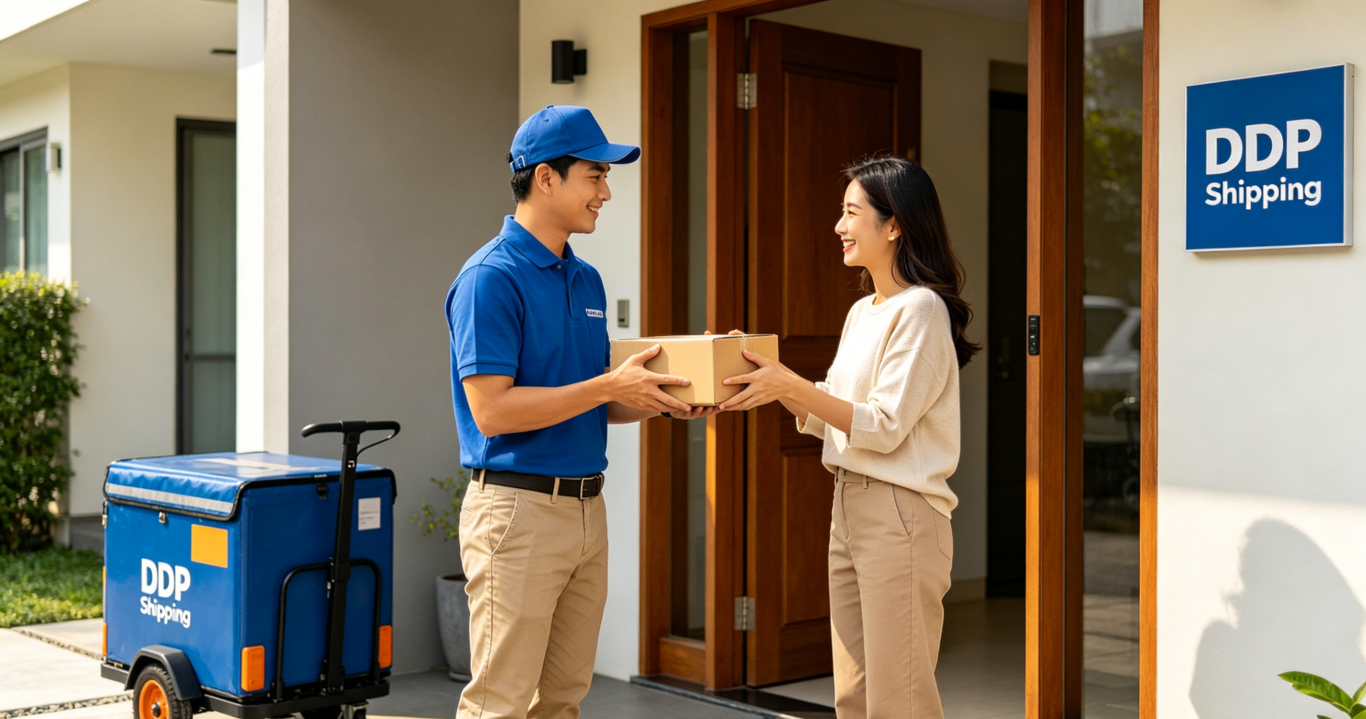
DDP Shipping from China to Singapore

DDP shipping is more and more popular for importers in Singapore. It’s one of the most convenient shipping methods for importers, as they only need to wait for the goods arrival. The freight forwarder will handle the full shipment, including pickup, China origin logistics, customs clearance in China and Singapore, documentation, duties & GST, and final delivery. It’s very suitable for first-time importers, SMEs and e-commerce sellers.

How Much Does Shipping from China to Singapore Cost?

Shipping Cost from China to Singapore

Express shipping from China to Singapore costs 2.31 – 2.69 USD/kg, and air freight costs 3.31 – 4.48 USD/kg. Sea freight LCL costs 107.46 – 119.40 USD/CBM from China to Singapore, and Sea Freight FCL costs 400-700 USD per container.

Remark: Below prices of general goods with standard packaging in May, 2026 are mainly for reference to evaluate your budget. If your goods contain batteries, magnetic, powder, irregular package and branded products, contact us for a more accurate quotation with your cargo type, quantity, weight and package type.

Shipping MethodReference Unit PricePricing Basis
Express2.31 – 2.69 USD/kgby Chargeable Weight
Air Freight3.31 – 4.48 USD/kgby Chargeable Weight
Sea Freight LCL107.46 – 119.40 USD/CBMby CBM
Sea Freight FCL400-700 USDby Container

How to Reduce Shipping Cost from China to Singapore?
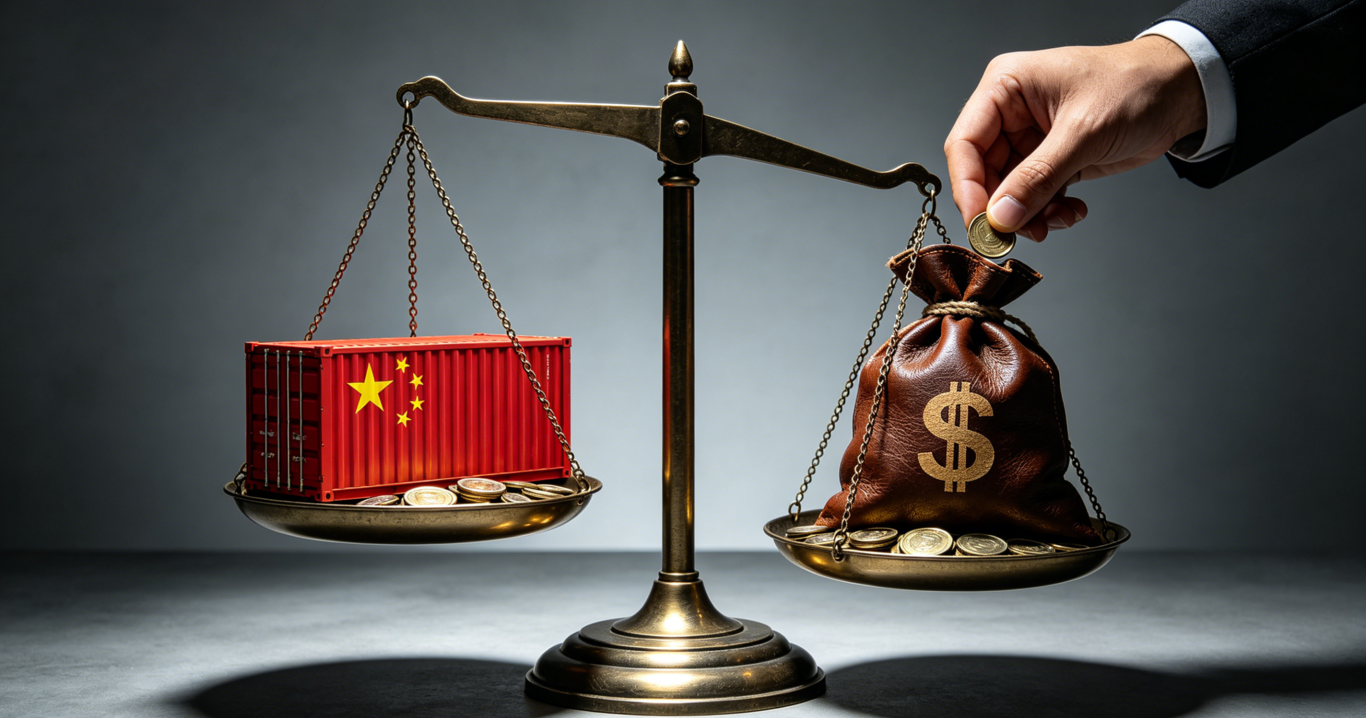
reduce cost from China to Singapore

Shipping cost has a great impact on profit margin of your business. As freight cost is calculated based on cargo weight and volume, you can save shipping cost by optimizing the packaging and cargo consolidation. It’s also important for importers to plan the shipment wisely and work with an experienced freight forwarder.

Consolidate and Repack Goods

Consolidating all your goods into one shipment and repacking with high-quality packaging can significantly reduce cargo volume and weight to cut costs. It will be very expensive to ship separately, as you need to pay more on freight cost, customs clearance, labor fees, port handling fees, and final delivery fees.

Plan Shipment in Advance

Freight costs fluctuate over time. Many factors have an impact on freight costs, such as flight schedule, peak season, holidays, fuel charges, port capacity and demand. Some trustworthy freight forwarders will inform importers about price fluctuation and advise shipping before price increases. Importers need to take all these information into consideration and plan shipment in advance to prevent financial loss due to sharp price increases.

Use the Most Suitable Incoterm

Incoterm can affect the overall shipping cost. For example, some freight forwarders may quote higher freight charges under CIF or DDP terms with hidden fees that you don’t notice. You can choose the suitable Incoterm based on your international logistics experience and balance the visibility, control, responsibility and risk.

Reduce Customs Clearance Risks

Unexpected customs issues often result in additional costs such as storage fees, inspection fees, demurrage charges, documentation amendment fees and even the penalties. Ensuring accurate and consistent product information on the shipping documents can help prevent customs additional charges.

Work with an Experienced Freight Forwarder

The freight forwarder who has experience in China-Singapore routes can provide best logistics portfolio, covering stable shipping routes, competitive price, and the most important thing is to prevent potential risk to save cost for importers. Working with an experienced freight leads to lower total landed cost.

What Are Common Hidden Fees When Shipping from China to Singapore?

Hidden Fees from China to Singapore

When shipping from China to Singapore, many importers may only focus on freight costs but overlook the total landed costs. With complex process of international logistics, additional charges may arise during the shipping process. Understanding these potential hidden fees in advance can help you estimate the total landed cost more accurately and avoid unexpected costs.

Hidden FeeWhen It May Apply
Consolidation FeeWhen cargo from multiple suppliers needs to be combined into one shipment
Repacking FeesCargo requires additional packaging, relabeling, or reinforcement before shipment
Port Charges (Origin & Destination)Handling, terminal, and operational charges at ports in China or Singapore
Documentation FeePrepare shipping documents
Customs Clearance FeeWhen customs declaration and import procedures are required
GSTImport customs clearance
Storage FeesCargo is out of free storage period
Cargo InsuranceMostly for high-value, fragile, or commercial shipments
Fuel SurchargesAir freight, express shipping, and sometimes sea freight when fuel prices fluctuate
Remote Area FeeDelivery to locations outside standard delivery areas
Handling Fees for Special CargoShipping batteries, liquids, cosmetics, food products, oversized cargo, or other regulated goods
Peak Season & Holiday SurchargesDuring New Year, Golden Week, Christmas, year-end holidays, or peak e-commerce seasons
Local Delivery ChargesFinal delivery from the port or airport to the designated location
Demurrage & Detention FeesContainers are not returned or collected within the free time allowed by the carrier or terminal

Some hidden fees like fuel surcharges can’t be controlled by importers or freight forwarders, while some hidden fees can be prevented by planning in advance. Importers need to confirm with the freight forwarder about potential charges may occur in the full process and negotiate with what service are included in the quotation to avoid hidden fees.

How Long Does Shipping from China to Singapore Take?
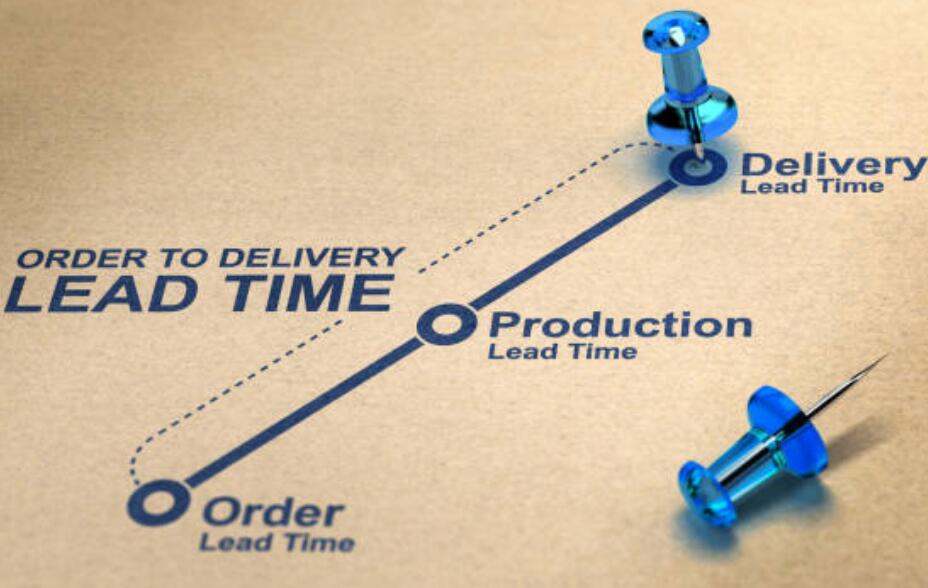
Transit Time from China to Singapore

Express shipping from China to Singapore takes 2-4 days, which is the fastest way. Air freight door-to-door takes 3-5 days, while air freight airport-to-airport takes 1-2 days. Sea freight seaport-to-seaport from China to Singapore takes 10-15 days, and sea freight door-to-door takes 15-20 days.

Shipping MethodTransit Time
Express (DHL, FedEx, UPS)2–4 days
Air Freight (Door to Door)3–5 days
Air Freight (Airport to Airport)1–2 days
Sea Freight (Seaport to Seaport)10–15 days
Sea Freight (Door to Door)15–20 days

Knowing the transit time from China to Singapore helps importers arrange the shipment based on their timeline. You can choose the most suitable shipping methods according to your priority.

How to Reduce Shipping Time from China to Singapore?

reduct shipping time China to Singapore

Besides choosing the fastest shipping method, what other measurements can reduce shipping time from China to Singapore. To ensure your shipment arrive in Singapore on time, importers need to choose the right shipping routes, speed up customs clearance and use an one-stop logistics solution.

Reduce Port & Warehouse Dwell Time

Shipment delays may be caused by waiting time at ports and warehouses. Port stay time is affected by port efficiency, such as port labor efficiency, port facilities and port congestion. Importers need to pay attention to the shipment status and prevent cargo stay at port and warehouse too long. This will not lead to shipment delays but also additional surcharges.

Improve Customs Clearance Efficiency

Customs clearance both in China and Singapore will affect the supply chain timeline. Shipment will be postponed by incomplete shipping documents, incorrect and inconsistent information. It’s necessary to make sure what kinds of document, certificates and permits are required based on your shipment details, and prepare all the documents in advance. This will reduce the risk of customs clearance delays.

Book Shipment in Advance

During the peak season and holidays, plan your shipment and book space in advance to prevent the port congestion and shortage of shipping lines and airlines.

Use End-to-End Shipping

Use an end-to-end one-stop logistics solution to reduce the coordination and communication time. Under the DDP term, one freight forwarder handles the entire shipment on behalf of the importer from pickup, transportation, customs clearance in China and Singapore, duties & GST, and final delivery. This result in the simplified process and less coordination between multiple parties.

Choose Stable Shipping Routes

Choosing a stable route shipping from China to Singapore can improve the logistics efficiency. Experienced freight forwarders usually provide multiple shipping options and can recommend the most reliable route based on your cargo type, urgency, and budget.

What Is the Shipping Process from China to Singapore?
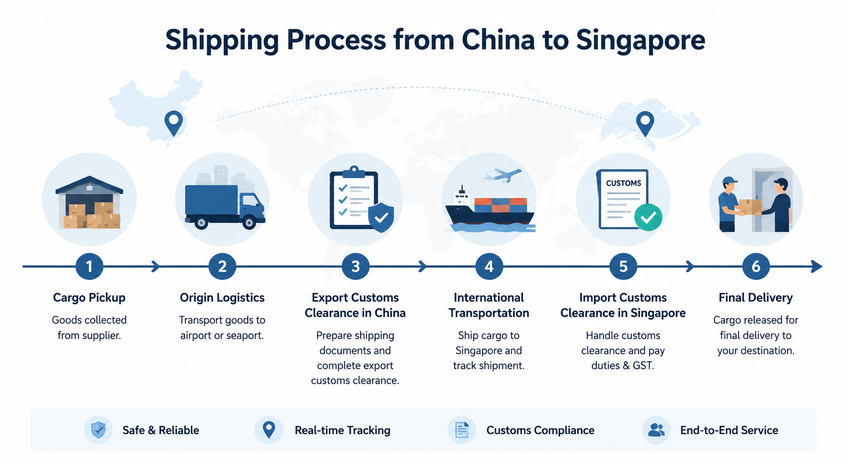
Shipping Process from China to Singapore

Shipping from China to Singapore is not complex to understand. Following is the standard workflow of shipping process from China to Singapore for importers.

Step 1: Cargo Pickup

After goods are available, importers only need to provide address of suppliers. The freight forwarder will arrange the goods collection.

Step 2: Origin Logistics

The freight forwarder transports the goods from their warehouse or suppliers’ factories to the airport or seaport.

Step 3: Export Customs Clearance in China

When clear the custom clearance, the freight forwarder can prepare all the shipping documents. Other permits and certificates may require suppliers to provide.

Step 4: International Transportation

During the international transportation, the freight forwarder will keep tracking shipment status and update to importers.

Step 5: Import Customs clearance in Singapore

When goods arrive in Singapore, the freight forwarder will handle the customs clearance and pay the duties & GST. Customs inspections may be conducted randomly on imported goods.

Step 6: Final Delivery

Once duties and GST have been paid, your cargo can be released to final delivery. Importers can coordinate with local delivery carrier to decide the agreed delivery time.

What Are the Main Shipping Routes from China to Singapore?

Although routes from China to Singapore is very mature and efficient, the choice of origin port or airport can still have a significant impact on transit time, shipping costs, and schedule frequency. South China, East China, and North China each offer different logistics advantages depending on the location of your suppliers and the urgency of your shipment. The table below highlights the main shipping routes and how different origin locations may affect your transportation plan.

Shipping MethodMain Origin Locations in ChinaDestination in SingaporeFeature
Sea FreightShenzhen, GuangzhouSingapore PortSouth China ports have more tight schedule with stable transit time. They are also the nearest port from China to Singapore.
Sea FreightNingbo, ShanghaiSingapore PortEast China ports are slightly farther from Singapore, with stable schedules suitable for sea freight of bulk cargo.
Sea FreightQingdaoSingapore PortNorth China ports are the farthest from Singapore, suitable for non-urgent bulk shipments.
Air FreightGuangzhou (CAN), Shenzhen (SZX)Singapore Changi Airport (SIN)Fast and stable routes from China to Singapore.
Air FreightShanghai (PVG)Singapore Changi Airport (SIN)Stable route for shipment in the eastern region.
Air FreightHong Kong (HKG)Singapore Changi Airport (SIN)Flexible route with fast speed, but costs higher.

What Documents Are Required for Shipping from China to Singapore?

Documents for China to Singaopre shipping

Normally, importers don’t need to make the shipping documents by themselves, but it’s still crucial to understand what documents are required for shipping from China to Singapore. Following are the typical shipping documents for your reference.

1. Commercial Invoice

Commercial invoice is mainly to verify supplier and importer’s company information, product type, HS code, description, origin, currency, unit price, product amount, and total value. Commercial invoice is the core documents for settlement and customs clearance. Duties and GST are based on the value on declared on commercial invoice. It’s normally provided by suppliers.

2. Packing List

Packing list is to provide cargo weight, size and packaging type. It helps freight forwarders and customs to verify the cargo. The information on the packing list is indispensable for freight cost inquiry. It’s normally provided by suppliers.

3. Bill of Lading (B/L)

Bill of lading serves as both proof of shipment and a document for cargo release for sea freight shipments. It’s normally provided by carrier.

4. Air Waybill (AWB)

Air waybill serves as both proof of shipment for air freight shipments. It’s normally provided by carrier.

5. Certificate of Origin (COO)

Certificate of Origin is used to prove the origin of the goods and apply for preferential tariff rates. It’s provided by suppliers.

6. Declaration Elements

Not all imported goods from China to Singapore need declaration elements. Products like motor, gearbox, pump, automatic machines, laser equipment require declaration elements for additional technical specifications such as brand, model, power rating, and application to support customs declarations and product classification.

7. Import Permit / License/ Certificates

For some restricted goods and special goods like batteries, electronics, equipment, medicines may require additional import permit, license and certificates for market access.

What Goods Are Prohibited or Restricted in Singapore?
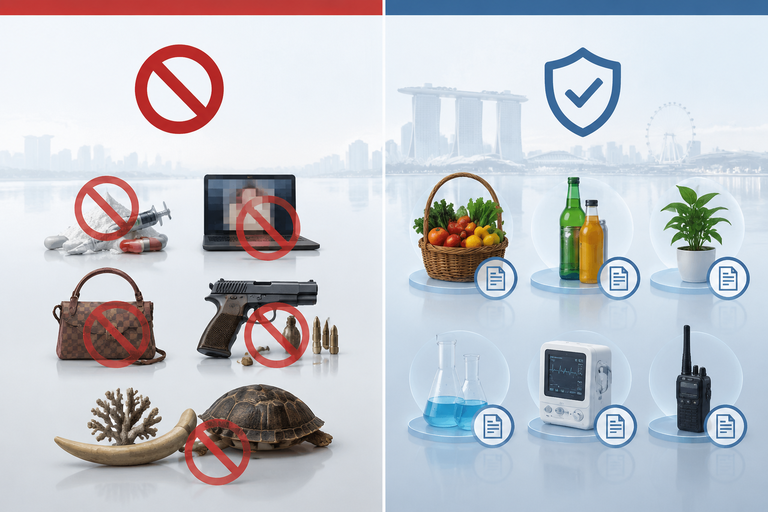
Prohibited or Restricted Goods in Singapore

Before import from China to Singapore, you need to know what kinds of products are prohibited and restricted in Singapore. This will help you prevent cargo detention, inspection and penalties at first place.

Prohibited Goods in Singapore

Following are the prohibited goods that can’t be imported in Singapore:

  • Counterfeit goods
  • Obscene publications
  • Certain weapons and explosive
  • Endangered wildlife products
  • Items banned under Singapore law

Restricted Goods in Singapore

Following are restricted goods that require additional permits and certificates:

  • Medicines and health products
  • Food items
  • Plants and animals
  • Drones
  • Telecommunications equipment
  • Weapons and replicas

Here to check more details about Controlled and Prohibited Goods for Imports in Singapore.

What Products Are Commonly Imported from China to Singapore?
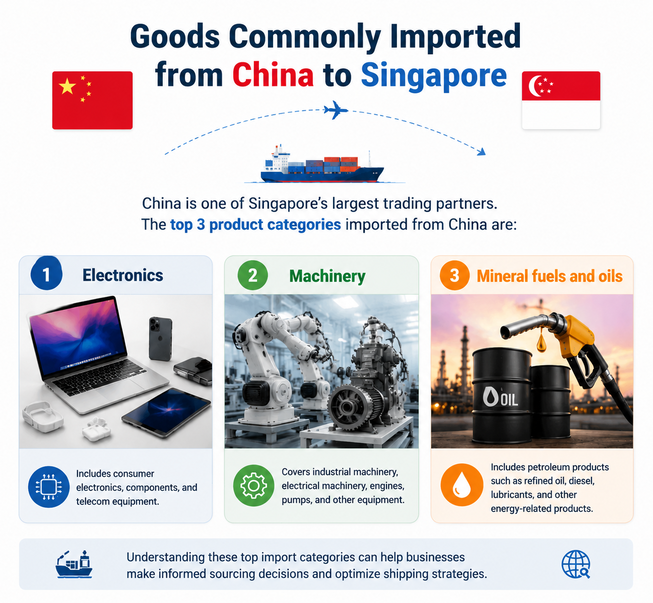
Top Import Products China to Singapore

China is one of Singapore’s largest trading partners. As trade between the two countries grows, freight forwarders act as bridges connecting Chinese suppliers with Singaporean importers. Understanding which products are most commonly imported can help businesses make informed sourcing decisions, optimize shipping strategies, and anticipate market trends.

The top three product categories imported by Singapore from China are:

  • Electronics
  • Machinery
  • Mineral fuels and oils

China is the global hub for electronics manufacturing with a complete supply chain, while Singapore serves as a regional hub for electronics re-exports and high-end electronics industries. As an industrial service and logistics center, Singapore’s demand for machinery is mainly for ports, factory automation, and construction infrastructure. In addition, Singapore has almost no natural energy resources and therefore relies heavily on imports. These factors make electronics, machinery, and mineral fuels and oils the main product categories Singapore imports from China.

How Does Customs Clearance Work in Singapore?
Customs Clearance in Singapore

Customs clearance in Singapore is not complicated for importers. Understanding the customs clearance process is essential to ensure smooth delivery, and importers will have more control over the full shipment.

Normally customs clearance in Singapore involves four steps, submit customs declaration with required documents and customs will review all the information to access the compliance. Next step is paying the duties and GST. Many importers may worry about customs inspections. Inspections undergo by customs randomly on imported goods and just make sure you have prepared all required documents. Once duties and GST have been paid, your cargo can be released.

NO.StepDescription
1Submit Customs DeclarationDeclare goods to Singapore Customs and submit shipping documents
2Pay Duties & GSTPay any applicable import duty and GST
3Customs Inspection (if required)Singapore Customs may inspect cargo
4Cargo ReleaseGoods cleared by customs and ready for final delivery

What Are the Import Duty and GST Rates in Singapore?
Import Duty & GST in Singapore

Singapore has one of the lowest import duties globally, with most goods being duty-free, making import more friendly even for small businesses. Knowing the duties and GST(Goods and Services Tax) value helps importers to calculate the total landed cost more accurately from China to Singapore.

  • Import duties: A percentage of the goods’ customs value or a fixed amount per unit of weight or quantity.
  • GST: A standard 9% GST applies to all imported goods.

If you are not unsure about the imported goods duties and GST, confirming with your freight forwarder is always a goods option.

Which Incoterm Is Best for Shipping from China to Singapore?
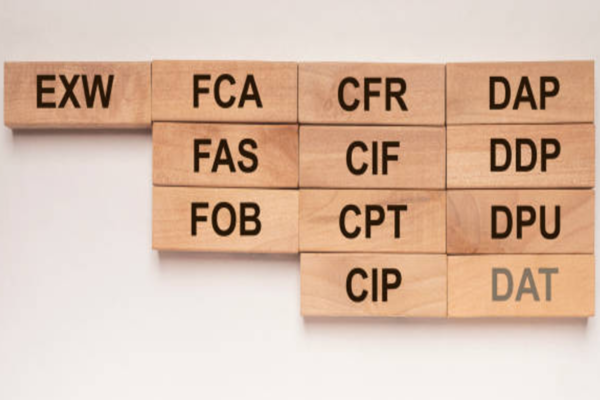
Incoterms for China to Singapore shipping

The best Incoterms®(International Commercial Terms) depends on importers’ experience in international logistics, cargo type and preference. We will introduce the most commonly used Incoterms and their suitable situations for importers. The most commonly used Incoterms include EXW, FOB, CIF, DAP, and DDP.

When discussing Incoterms, the responsibilities are defined between the seller and the buyer. Freight forwarders are not parties to the Incoterms rules and they simply act on behalf of either the seller or the buyer to arrange transportation and related logistics services.

EXW (Ex Works)

The seller makes all the goods available at the factory. The buyer is responsible for the full shipment, including pickup, export and import customs clearance, international transportation and final delivery. This Incoterm is not suitable for beginner, as the buyer takes the biggest responsibility and risk of the full process. If you are the experienced importers who have long-term freight forwarders, you can arrange the shipment by yourself and control the cost.

FOB (Free On Board)

Under the FOB, the seller only need to make goods available on the vessel at the port of origin and handle the export customs clearance. The buyer handle the international transportation, import customs clearance, duties, GST and final delivery. FOB is normally used for sea freight. It’s suitable for importers who have their own logistics network or local logistics partners.

CIF (Cost, Insurance and Freight)

The seller arranges and pays for ocean freight and insurance to the destination port. The buyer handles import clearance, duties, GST, and final delivery. It’s convenient for buyers who do not want to manage ocean freight. Freight and insurance are included in the supplier’s quotation. CIF works for importers who have local delivery force and can handle the import customs clearance.

DAP (Delivered at Place)

The seller arranges transportation to the agreed destination in Singapore. The buyer is responsible for import clearance, duties and GST. DAP term is very suitable for large business who want to simplify the logistics and save the coordination time. The buyer only needs to handle the import customs and pay the duties and GST, and then wait for the goods arrival.

DDP (Delivered Duty Paid)

DDP is the opposite of the EXW. The seller takes all the responsibility of the full shipment, including origin handling, export and import customs clearance, international transportation, duties, GST and final delivery. It’s the most hassle-free solution for the buyer, as they only need to wait for good arrival at doorstep. First-time importers, small business and e-commerce sellers can choose DDP to streamline the supply chain.

What Are the Common Problems When Shipping from China to Singapore?

problems in China to Singapore shipment

Even after planning the shipment properly, what unexpected problems may still occur? Not everything in the shipment can be controlled by importers. The common problems in the shipment from China to Singapore may cause by human factors, natural factors and force majeure. Let’s make a quick summary of the most common problems and how to prevent them.

Common ProblemWhat Causes ItHow to Prevent It
Supplier DelaysProduction delays or incomplete orders. Bad communication and coordination can also lead to pickup delays.Confirm production timeline clearly.
Cargo Damage or LossHandling accidents, weather, transportation incidents, or bad packaging.Purchase cargo insurance. Pack goods with reinforcement and high-quality packaging.
Incorrect DocumentationWrong HS code, product description, or value declaration.Verify shipping documents and make sure all the documents are consistent and correct.
Peak Season Capacity ShortagesHoliday seasons and increased demand.Book shipments 3-4 weeks in advance.
Communication IssuesMultiple suppliers, forwarders, and agents involvedSimplify the communication and contact person.

Why Do You Need Cargo Insurance When Shipping from China to Singapore?
Cargo Insurance for China to Singapore

Cargo insurance provides financial protection against the loss, damage, or theft of goods during international transportation. It is crucial for importers to manage risks. Cargo accidents may occur due to long transit times and this is why insurance is a good option for sea freight. But potential risk also occurs because of port handling, loading, weather, and other unforeseen factors. So when you ship following kinds of goods, it’s highly recommended to buy the insurance.

  • High-value products, such as electronics, machinery, pharmaceuticals.
  • Fragile goods, like glass, furniture, and sensitive to temperature and humidity.
  • First time importers who have less control over the shipment.
  • Cooperate with a new freight forwarder.
  • Unstable routes or policies changes.

Cargo insurance provides additional financial protection, helping businesses minimize potential losses and maintain supply chain stability. Importers can decide if to buy insurance according to your cargo value, transit time and shipping method.

What Is the Best Shipping Method for E-commerce Sellers in Singapore?
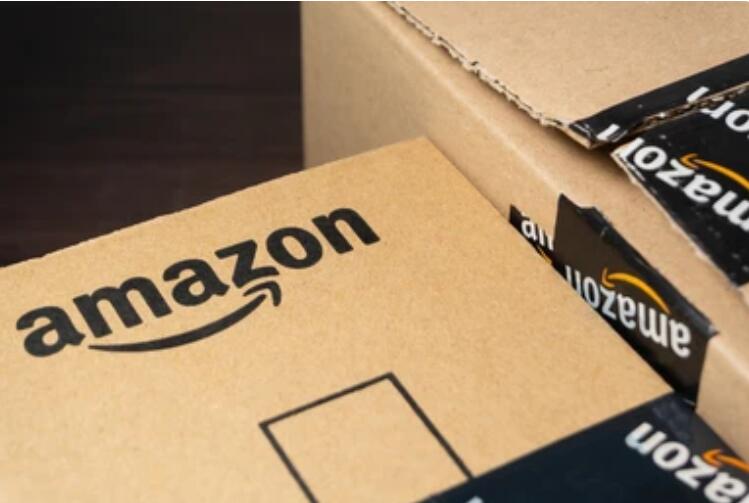
E-commerce Solution from China to Singapore

For most e-commerce sellers in Singapore, the best shipping method is not necessarily the fastest or the cheapest one. The ideal solution is the one that balances inventory turnover, shipping costs, convenience, and customer satisfaction. This is why so many e-commerce sellers choose DDP shipping from China to Singapore. For the e-commerce sellers, DDP shipping include some decisive services.

  • Consolidation: Most e-commerce sellers have more than one supplier. They need consolidation service to reduce freight cost.
  • Repack and relabel: To meet the requirement of customs clearance and warehouse inbounds, e-commerce sellers need a freight forwarder to check the cargo packaging and label compliance.
  • Prepaid duties and GST: under the DDP, e-commerce sellers don’t need to deal with the duties and GST.
  • Door-to-door hassle free solution: the freight forwarder arrange the warehouse inbounds appointment and delivery to the designated warehouse.

DDP shipping provide e-commerce sellers with the most convenient logistics solution and they can focus on business instead of worried about shipment.

Can You Ship Directly from Taobao or 1688 to Singapore?

Yes, it is feasible to ship directly from Taobao and 1688 to Singapore. 1688 is the China domestic wholesale platform without international logistics service and Taobao is the China domestic e-commerce platform with limited international logistics service.

Most importers choose to work with a China-based freight forwarder who can provide competitive price and flexible shipping methods from China to Singapore. Importers can provide the address of your freight forwarder to suppliers and suppliers on Taobao and 1688 can directly ship to freight forwarder’s warehouse. Here to check the Complete Guide Shipping from Taobao to Singapore.

How to Choose the Best Freight Forwarder from China to Singapore?
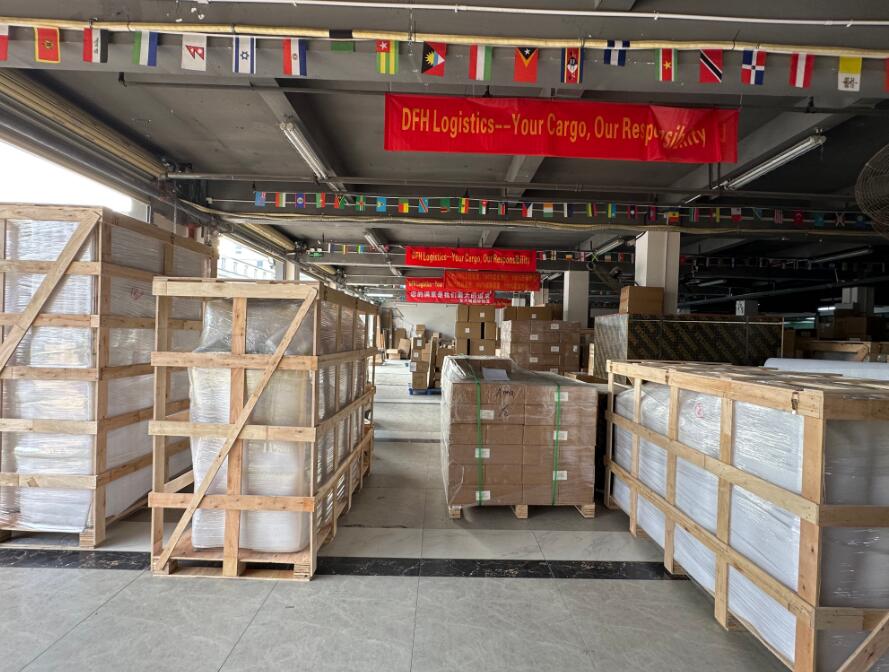
Freight Forwarder from China to Singapore

Choosing the best freight forwarder from China to Singapore is not that hard. There are mainly 3 ways to find your best logistics partner:

  • Search on google as the first round of screening. You will find many well-known freight forwarders. You may wonder if their services match with the rank on the page and afraid of the expensive shipping rates.
  • Move to next step: review feedback of other importers. Many importers will share their experience working with freight forwarders on Reddit, Linkedin, Trustpilot, and their feedback are the best reference.
  • Ask your friends for recommendation.

Here to check the Top 6 Freight Forwarder China to Singapore.

Why Choose DFH Logistics for Shipping from China to Singapore?
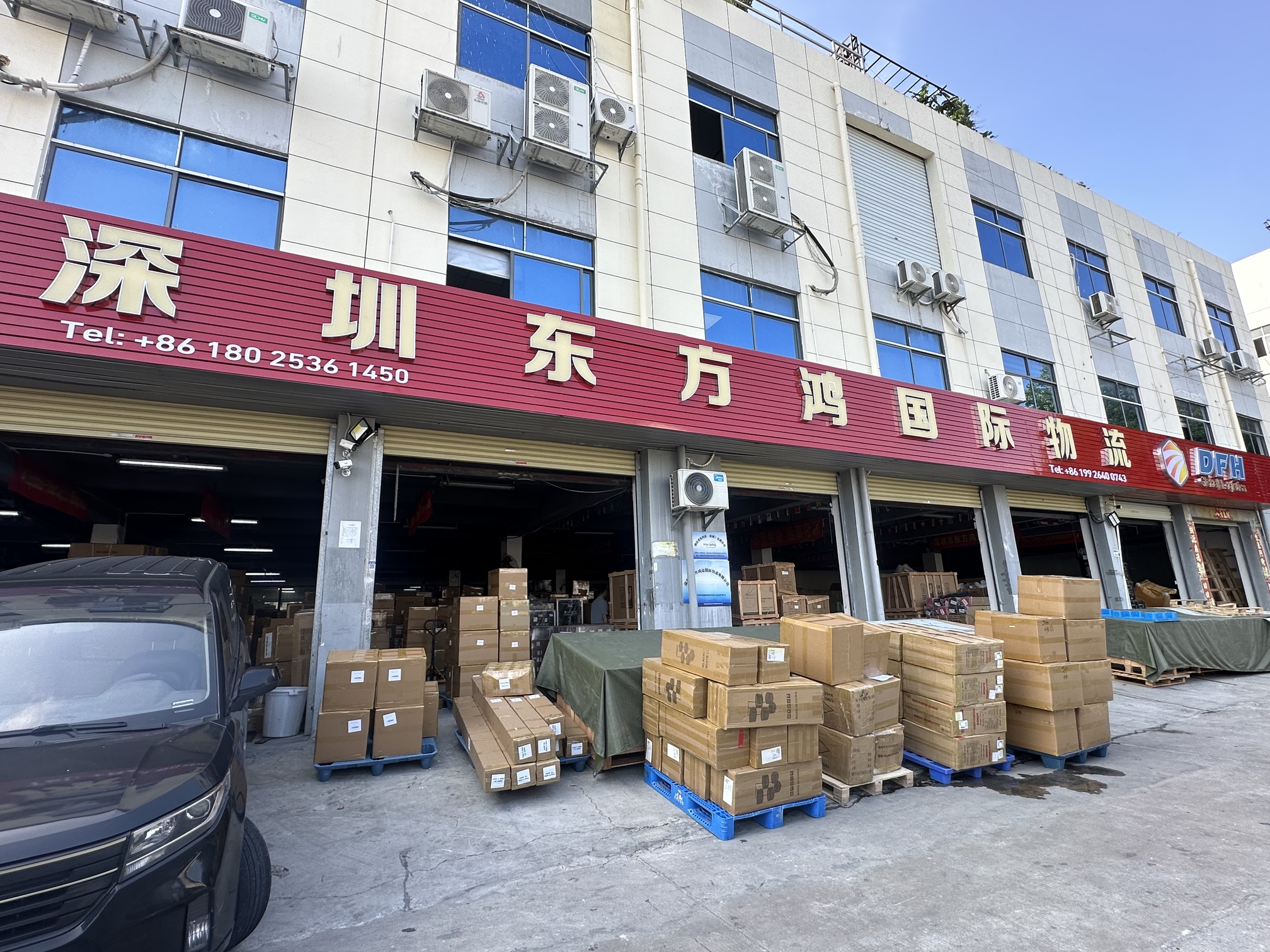
DFH Logistics Shipping from China to Singapore

DFH Logistics specializes in international logistics with more than 13 years of experience. We have served over 30,000 global clients with one-stop logistics solutions. Our comprehensive end-to-end services include pickup, consolidation, repacking, relabeling, cargo inspection, free 30 days warehousing, cargo insurance, import and export customs clearance, documentation, payment of duties & GST, final delivery and 24/7 customer support. Moreover, we boast the following advantages.

Competitive Price without Hidden Fees

DFH Logistics has established long-term partnership with global shipping lines, airlines and couriers to provide more competitive freight costs for our clients. We will provide quotation with cost breakdown and detailed service coverage. You don’t need to worry about hidden fees or any additional surcharge in the full shipment.

Flexible Shipping Routes

With powerful operation capacity and extensive logistics network, DFH Logistics offers flexible shipping solutions tailored to different cargo types, budgets, and transit time requirements. Whether you need sea freight, air freight, express delivery, or DDP shipping, we help you choose the most cost-effective and reliable China-Singapore routes for your business.

Dedicated Customer Support

Our dedicated customer service team provides timely updates and professional support throughout the full shipping process by phone, email, wechat and whatsapp. We ensure clear communication and quick responses in every step to keep your shipments running smoothly.

Quick summary about DFH Logistics:

ITEMDETAILS
HeadquartersShenzhen, China
Founded in2013
Websitehttps://dfhfreight.com/
Phone/WhatsApp+86 18025361450
Email[email protected]; [email protected]
AddressF1,No.7, YingJin Industrial Park North Area, YueSheng 3rd Road, Fuhai Street, FuYong Town, Bao’an District, ShenZhen, GuangDong Province, China. 518103
Core ServiceShipping from China to Singapore by air, sea, express, and DDP door-to-door shipping.
Main MarketSingapore, Hungary, Spain, France, USA, Ireland, Italy, Netherlands, Germany, UK, UAE, Australia, Canada, Europe, South Africa, Philippines, Malaysia, Thailand.
Suitable ForAmazon FBA Sellers, Dropshipping, Global Importers and Buyers, Wholesaler, Bulk Shipment, General Goods, Oversized Cargo, Dangerous Goods, Special Cargo.
Social MediumTiktok/youtube/instagram/facebook: @chinafreightforwarderdfh

Final Thoughts

Working with an experienced freight forwarder such as DFH Logistics can make shipping from China to Singapore safer, smoother, and more efficient. We do much more than simply arrange the transportation. We help importers reduce potential risks, avoid unexpected costs, streamline supply chains, and improve overall logistics performance. Whether you are a first-time importer, an e-commerce seller, or an established business, our team can provide customized shipping solutions tailored to your cargo type, budget, and timeline. Contact DFH Logistics today for a competitive quotation and professional logistics support.

Shipping from China to Singapore: Complete Guide to Cost, Transit Time & Customs

jingJune 11, 20260 comments

Singapore is one of the biggest logistics hubs in Southeast Asia. When shipping from China…

Singapore is one of the biggest logistics hubs in Southeast Asia. When shipping from China to Singapore, importers don’t need to worry about flight or vessel schedule. However, they struggle with unpredictable total landed cost, customs clearance issues, and goods consolidation of multiple suppliers. In this guide, I will tell you everything you need to know about shipping from China to Singapore, including freight cost, transit time, the best shipping method, customs clearance, GST, and risks with corresponding tips.

How to Ship from China to Singapore?

China to Singapore Shipping Solutions

Importers can ship from China to Singapore by working with a China-based freight forwarder, supplier arranging the shipment directly and using a Singapore-based freight forwarder. These three options have their own advantages and disadvantages, and each option is suitable for different situations. Let’s make a comparison of them.

OptionProsConsSuitable for
China-based Freight Forwarder– Best coordination in origin side, especially when you have multiple suppliers.
– Logistics specialist: can provide flexible shipping routes with competitive price.
– Support customized service.
– Fast updates on shipment status and timely feedback.
Service quality varies among freight forwarders.Importers who have more than one supplier and who want to reduce total landed cost.
Supplier Arrange the Shipment– Simple and convenient.
– No need to find a freight forwarder by yourself.
– Nontransparent shipping cost.
– Limited shipping methods.
– If you have multiple suppliers, shipping separately is expensive.
– Limited control over shipment for importers.
First-time importers and sample shipment.
Singapore-based Freight Forwarder– Easier communication with local service providers.
– Better understanding of Singapore import regulations and customs requirements.
– Good local support.
– Less control over the China side.
– May need a agent in China to handle the consolidation and logistics.
– Higher shipping cost.
Importers that prefer working with local logistics providers.

So, no matter you are a first-time importer or established business, it’s highly recommended to choose a professional China-based freight forwarder who can provide customized logistics solutions with the most competitive price.

What Is the Best Shipping Method from China to Singapore?

The best shipping method from China to Singapore depends on your specific situation. Importers need to consider their cargo type, budget, and required service. The main shipping methods from China to Singapore include air freight, express, sea freight and DDP shipping.

Air Freight from China to Singapore

Air Freight from China to Singapore

Air freight allows importers to enjoy fast transit times and flexible flight schedules. It’s suitable for time-sensitive shipment and high-value cargo shipping. Air freight is much safer than sea freight due to a shorter shipping time, but it is more expensive than sea freight.

Sea Freight from China to Singapore

sea freight from China to Singapore

Sea freight is the most cost effective way to ship from China to Singapore, but it has the longest transit time. It’s very suitable for bulk shipment, oversized cargo and special goods shipping. Sea freight provides FCL(Full Container Load) and LCL(Less than Container Load) for options.

Express Freight from China to Singapore

Express Freight from China to Singapore

Express freight is the fastest way to ship from China to Singapore, but it’s more expensive than sea freight. Compared with standard air freight, express freight handled by couriers like DHL, FedEx, and UPS has very strict regulations on cargo type, dimension and weight. It’s suitable for sample shipment, urgent files, and small time-sensitive parcel.

DDP Shipping from China to Singapore

DDP Shipping from China to Singapore

DDP shipping is more and more popular for importers in Singapore. It’s one of the most convenient shipping methods for importers, as they only need to wait for the goods arrival. The freight forwarder will handle the full shipment, including pickup, China origin logistics, customs clearance in China and Singapore, documentation, duties & GST, and final delivery. It’s very suitable for first-time importers, SMEs and e-commerce sellers.

How Much Does Shipping from China to Singapore Cost?

Shipping Cost from China to Singapore

Express shipping from China to Singapore costs 2.31 – 2.69 USD/kg, and air freight costs 3.31 – 4.48 USD/kg. Sea freight LCL costs 107.46 – 119.40 USD/CBM from China to Singapore, and Sea Freight FCL costs 400-700 USD per container.

Remark: Below prices of general goods with standard packaging in May, 2026 are mainly for reference to evaluate your budget. If your goods contain batteries, magnetic, powder, irregular package and branded products, contact us for a more accurate quotation with your cargo type, quantity, weight and package type.

Shipping MethodReference Unit PricePricing Basis
Express2.31 – 2.69 USD/kgby Chargeable Weight
Air Freight3.31 – 4.48 USD/kgby Chargeable Weight
Sea Freight LCL107.46 – 119.40 USD/CBMby CBM
Sea Freight FCL400-700 USDby Container

How to Reduce Shipping Cost from China to Singapore?

reduce cost from China to Singapore

Shipping cost has a great impact on profit margin of your business. As freight cost is calculated based on cargo weight and volume, you can save shipping cost by optimizing the packaging and cargo consolidation. It’s also important for importers to plan the shipment wisely and work with an experienced freight forwarder.

Consolidate and Repack Goods

Consolidating all your goods into one shipment and repacking with high-quality packaging can significantly reduce cargo volume and weight to cut costs. It will be very expensive to ship separately, as you need to pay more on freight cost, customs clearance, labor fees, port handling fees, and final delivery fees.

Plan Shipment in Advance

Freight costs fluctuate over time. Many factors have an impact on freight costs, such as flight schedule, peak season, holidays, fuel charges, port capacity and demand. Some trustworthy freight forwarders will inform importers about price fluctuation and advise shipping before price increases. Importers need to take all these information into consideration and plan shipment in advance to prevent financial loss due to sharp price increases.

Use the Most Suitable Incoterm

Incoterm can affect the overall shipping cost. For example, some freight forwarders may quote higher freight charges under CIF or DDP terms with hidden fees that you don’t notice. You can choose the suitable Incoterm based on your international logistics experience and balance the visibility, control, responsibility and risk.

Reduce Customs Clearance Risks

Unexpected customs issues often result in additional costs such as storage fees, inspection fees, demurrage charges, documentation amendment fees and even the penalties. Ensuring accurate and consistent product information on the shipping documents can help prevent customs additional charges.

Work with an Experienced Freight Forwarder

The freight forwarder who has experience in China-Singapore routes can provide best logistics portfolio, covering stable shipping routes, competitive price, and the most important thing is to prevent potential risk to save cost for importers. Working with an experienced freight leads to lower total landed cost.

What Are Common Hidden Fees When Shipping from China to Singapore?

Hidden Fees from China to Singapore

When shipping from China to Singapore, many importers may only focus on freight costs but overlook the total landed costs. With complex process of international logistics, additional charges may arise during the shipping process. Understanding these potential hidden fees in advance can help you estimate the total landed cost more accurately and avoid unexpected costs.

Hidden FeeWhen It May Apply
Consolidation FeeWhen cargo from multiple suppliers needs to be combined into one shipment
Repacking FeesCargo requires additional packaging, relabeling, or reinforcement before shipment
Port Charges (Origin & Destination)Handling, terminal, and operational charges at ports in China or Singapore
Documentation FeePrepare shipping documents
Customs Clearance FeeWhen customs declaration and import procedures are required
GSTImport customs clearance
Storage FeesCargo is out of free storage period
Cargo InsuranceMostly for high-value, fragile, or commercial shipments
Fuel SurchargesAir freight, express shipping, and sometimes sea freight when fuel prices fluctuate
Remote Area FeeDelivery to locations outside standard delivery areas
Handling Fees for Special CargoShipping batteries, liquids, cosmetics, food products, oversized cargo, or other regulated goods
Peak Season & Holiday SurchargesDuring New Year, Golden Week, Christmas, year-end holidays, or peak e-commerce seasons
Local Delivery ChargesFinal delivery from the port or airport to the designated location
Demurrage & Detention FeesContainers are not returned or collected within the free time allowed by the carrier or terminal

Some hidden fees like fuel surcharges can’t be controlled by importers or freight forwarders, while some hidden fees can be prevented by planning in advance. Importers need to confirm with the freight forwarder about potential charges may occur in the full process and negotiate with what service are included in the quotation to avoid hidden fees.

How Long Does Shipping from China to Singapore Take?

Transit Time from China to Singapore

Express shipping from China to Singapore takes 2-4 days, which is the fastest way. Air freight door-to-door takes 3-5 days, while air freight airport-to-airport takes 1-2 days. Sea freight seaport-to-seaport from China to Singapore takes 10-15 days, and sea freight door-to-door takes 15-20 days.

Shipping MethodTransit Time
Express (DHL, FedEx, UPS)2–4 days
Air Freight (Door to Door)3–5 days
Air Freight (Airport to Airport)1–2 days
Sea Freight (Seaport to Seaport)10–15 days
Sea Freight (Door to Door)15–20 days

Knowing the transit time from China to Singapore helps importers arrange the shipment based on their timeline. You can choose the most suitable shipping methods according to your priority.

How to Reduce Shipping Time from China to Singapore?

reduct shipping time China to Singapore

Besides choosing the fastest shipping method, what other measurements can reduce shipping time from China to Singapore. To ensure your shipment arrive in Singapore on time, importers need to choose the right shipping routes, speed up customs clearance and use an one-stop logistics solution.

Reduce Port & Warehouse Dwell Time

Shipment delays may be caused by waiting time at ports and warehouses. Port stay time is affected by port efficiency, such as port labor efficiency, port facilities and port congestion. Importers need to pay attention to the shipment status and prevent cargo stay at port and warehouse too long. This will not lead to shipment delays but also additional surcharges.

Improve Customs Clearance Efficiency

Customs clearance both in China and Singapore will affect the supply chain timeline. Shipment will be postponed by incomplete shipping documents, incorrect and inconsistent information. It’s necessary to make sure what kinds of document, certificates and permits are required based on your shipment details, and prepare all the documents in advance. This will reduce the risk of customs clearance delays.

Book Shipment in Advance

During the peak season and holidays, plan your shipment and book space in advance to prevent the port congestion and shortage of shipping lines and airlines.

Use End-to-End Shipping

Use an end-to-end one-stop logistics solution to reduce the coordination and communication time. Under the DDP term, one freight forwarder handles the entire shipment on behalf of the importer from pickup, transportation, customs clearance in China and Singapore, duties & GST, and final delivery. This result in the simplified process and less coordination between multiple parties.

Choose Stable Shipping Routes

Choosing a stable route shipping from China to Singapore can improve the logistics efficiency. Experienced freight forwarders usually provide multiple shipping options and can recommend the most reliable route based on your cargo type, urgency, and budget.

What Is the Shipping Process from China to Singapore?

Shipping Process from China to Singapore

Shipping from China to Singapore is not complex to understand. Following is the standard workflow of shipping process from China to Singapore for importers.

Step 1: Cargo Pickup

After goods are available, importers only need to provide address of suppliers. The freight forwarder will arrange the goods collection.

Step 2: Origin Logistics

The freight forwarder transports the goods from their warehouse or suppliers’ factories to the airport or seaport.

Step 3: Export Customs Clearance in China

When clear the custom clearance, the freight forwarder can prepare all the shipping documents. Other permits and certificates may require suppliers to provide.

Step 4: International Transportation

During the international transportation, the freight forwarder will keep tracking shipment status and update to importers.

Step 5: Import Customs clearance in Singapore

When goods arrive in Singapore, the freight forwarder will handle the customs clearance and pay the duties & GST. Customs inspections may be conducted randomly on imported goods.

Step 6: Final Delivery

Once duties and GST have been paid, your cargo can be released to final delivery. Importers can coordinate with local delivery carrier to decide the agreed delivery time.

What Are the Main Shipping Routes from China to Singapore?

Although routes from China to Singapore is very mature and efficient, the choice of origin port or airport can still have a significant impact on transit time, shipping costs, and schedule frequency. South China, East China, and North China each offer different logistics advantages depending on the location of your suppliers and the urgency of your shipment. The table below highlights the main shipping routes and how different origin locations may affect your transportation plan.

Shipping MethodMain Origin Locations in ChinaDestination in SingaporeFeature
Sea FreightShenzhen, GuangzhouSingapore PortSouth China ports have more tight schedule with stable transit time. They are also the nearest port from China to Singapore.
Sea FreightNingbo, ShanghaiSingapore PortEast China ports are slightly farther from Singapore, with stable schedules suitable for sea freight of bulk cargo.
Sea FreightQingdaoSingapore PortNorth China ports are the farthest from Singapore, suitable for non-urgent bulk shipments.
Air FreightGuangzhou (CAN), Shenzhen (SZX)Singapore Changi Airport (SIN)Fast and stable routes from China to Singapore.
Air FreightShanghai (PVG)Singapore Changi Airport (SIN)Stable route for shipment in the eastern region.
Air FreightHong Kong (HKG)Singapore Changi Airport (SIN)Flexible route with fast speed, but costs higher.

What Documents Are Required for Shipping from China to Singapore?

Documents for China to Singaopre shipping

Normally, importers don’t need to make the shipping documents by themselves, but it’s still crucial to understand what documents are required for shipping from China to Singapore. Following are the typical shipping documents for your reference.

1. Commercial Invoice

Commercial invoice is mainly to verify supplier and importer’s company information, product type, HS code, description, origin, currency, unit price, product amount, and total value. Commercial invoice is the core documents for settlement and customs clearance. Duties and GST are based on the value on declared on commercial invoice. It’s normally provided by suppliers.

2. Packing List

Packing list is to provide cargo weight, size and packaging type. It helps freight forwarders and customs to verify the cargo. The information on the packing list is indispensable for freight cost inquiry. It’s normally provided by suppliers.

3. Bill of Lading (B/L)

Bill of lading serves as both proof of shipment and a document for cargo release for sea freight shipments. It’s normally provided by carrier.

4. Air Waybill (AWB)

Air waybill serves as both proof of shipment for air freight shipments. It’s normally provided by carrier.

5. Certificate of Origin (COO)

Certificate of Origin is used to prove the origin of the goods and apply for preferential tariff rates. It’s provided by suppliers.

6. Declaration Elements

Not all imported goods from China to Singapore need declaration elements. Products like motor, gearbox, pump, automatic machines, laser equipment require declaration elements for additional technical specifications such as brand, model, power rating, and application to support customs declarations and product classification.

7. Import Permit / License/ Certificates

For some restricted goods and special goods like batteries, electronics, equipment, medicines may require additional import permit, license and certificates for market access.

What Goods Are Prohibited or Restricted in Singapore?

Prohibited or Restricted Goods in Singapore

Before import from China to Singapore, you need to know what kinds of products are prohibited and restricted in Singapore. This will help you prevent cargo detention, inspection and penalties at first place.

Prohibited Goods in Singapore

Following are the prohibited goods that can’t be imported in Singapore:

Restricted Goods in Singapore

Following are restricted goods that require additional permits and certificates:

Here to check more details about Controlled and Prohibited Goods for Imports in Singapore.

What Products Are Commonly Imported from China to Singapore?

Top Import Products China to Singapore

China is one of Singapore’s largest trading partners. As trade between the two countries grows, freight forwarders act as bridges connecting Chinese suppliers with Singaporean importers. Understanding which products are most commonly imported can help businesses make informed sourcing decisions, optimize shipping strategies, and anticipate market trends.

The top three product categories imported by Singapore from China are:

China is the global hub for electronics manufacturing with a complete supply chain, while Singapore serves as a regional hub for electronics re-exports and high-end electronics industries. As an industrial service and logistics center, Singapore’s demand for machinery is mainly for ports, factory automation, and construction infrastructure. In addition, Singapore has almost no natural energy resources and therefore relies heavily on imports. These factors make electronics, machinery, and mineral fuels and oils the main product categories Singapore imports from China.

How Does Customs Clearance Work in Singapore?

Customs Clearance in Singapore

Customs clearance in Singapore is not complicated for importers. Understanding the customs clearance process is essential to ensure smooth delivery, and importers will have more control over the full shipment.

Normally customs clearance in Singapore involves four steps, submit customs declaration with required documents and customs will review all the information to access the compliance. Next step is paying the duties and GST. Many importers may worry about customs inspections. Inspections undergo by customs randomly on imported goods and just make sure you have prepared all required documents. Once duties and GST have been paid, your cargo can be released.

NO.StepDescription
1Submit Customs DeclarationDeclare goods to Singapore Customs and submit shipping documents
2Pay Duties & GSTPay any applicable import duty and GST
3Customs Inspection (if required)Singapore Customs may inspect cargo
4Cargo ReleaseGoods cleared by customs and ready for final delivery

What Are the Import Duty and GST Rates in Singapore?

Import Duty & GST in Singapore

Singapore has one of the lowest import duties globally, with most goods being duty-free, making import more friendly even for small businesses. Knowing the duties and GST(Goods and Services Tax) value helps importers to calculate the total landed cost more accurately from China to Singapore.

If you are not unsure about the imported goods duties and GST, confirming with your freight forwarder is always a goods option.

Which Incoterm Is Best for Shipping from China to Singapore?

Incoterms for China to Singapore shipping

The best Incoterms®(International Commercial Terms) depends on importers’ experience in international logistics, cargo type and preference. We will introduce the most commonly used Incoterms and their suitable situations for importers. The most commonly used Incoterms include EXW, FOB, CIF, DAP, and DDP.

When discussing Incoterms, the responsibilities are defined between the seller and the buyer. Freight forwarders are not parties to the Incoterms rules and they simply act on behalf of either the seller or the buyer to arrange transportation and related logistics services.

EXW (Ex Works)

The seller makes all the goods available at the factory. The buyer is responsible for the full shipment, including pickup, export and import customs clearance, international transportation and final delivery. This Incoterm is not suitable for beginner, as the buyer takes the biggest responsibility and risk of the full process. If you are the experienced importers who have long-term freight forwarders, you can arrange the shipment by yourself and control the cost.

FOB (Free On Board)

Under the FOB, the seller only need to make goods available on the vessel at the port of origin and handle the export customs clearance. The buyer handle the international transportation, import customs clearance, duties, GST and final delivery. FOB is normally used for sea freight. It’s suitable for importers who have their own logistics network or local logistics partners.

CIF (Cost, Insurance and Freight)

The seller arranges and pays for ocean freight and insurance to the destination port. The buyer handles import clearance, duties, GST, and final delivery. It’s convenient for buyers who do not want to manage ocean freight. Freight and insurance are included in the supplier’s quotation. CIF works for importers who have local delivery force and can handle the import customs clearance.

DAP (Delivered at Place)

The seller arranges transportation to the agreed destination in Singapore. The buyer is responsible for import clearance, duties and GST. DAP term is very suitable for large business who want to simplify the logistics and save the coordination time. The buyer only needs to handle the import customs and pay the duties and GST, and then wait for the goods arrival.

DDP (Delivered Duty Paid)

DDP is the opposite of the EXW. The seller takes all the responsibility of the full shipment, including origin handling, export and import customs clearance, international transportation, duties, GST and final delivery. It’s the most hassle-free solution for the buyer, as they only need to wait for good arrival at doorstep. First-time importers, small business and e-commerce sellers can choose DDP to streamline the supply chain.

What Are the Common Problems When Shipping from China to Singapore?

problems in China to Singapore shipment

Even after planning the shipment properly, what unexpected problems may still occur? Not everything in the shipment can be controlled by importers. The common problems in the shipment from China to Singapore may cause by human factors, natural factors and force majeure. Let’s make a quick summary of the most common problems and how to prevent them.

Common ProblemWhat Causes ItHow to Prevent It
Supplier DelaysProduction delays or incomplete orders. Bad communication and coordination can also lead to pickup delays.Confirm production timeline clearly.
Cargo Damage or LossHandling accidents, weather, transportation incidents, or bad packaging.Purchase cargo insurance. Pack goods with reinforcement and high-quality packaging.
Incorrect DocumentationWrong HS code, product description, or value declaration.Verify shipping documents and make sure all the documents are consistent and correct.
Peak Season Capacity ShortagesHoliday seasons and increased demand.Book shipments 3-4 weeks in advance.
Communication IssuesMultiple suppliers, forwarders, and agents involvedSimplify the communication and contact person.

Why Do You Need Cargo Insurance When Shipping from China to Singapore?

Cargo Insurance for China to Singapore

Cargo insurance provides financial protection against the loss, damage, or theft of goods during international transportation. It is crucial for importers to manage risks. Cargo accidents may occur due to long transit times and this is why insurance is a good option for sea freight. But potential risk also occurs because of port handling, loading, weather, and other unforeseen factors. So when you ship following kinds of goods, it’s highly recommended to buy the insurance.

Cargo insurance provides additional financial protection, helping businesses minimize potential losses and maintain supply chain stability. Importers can decide if to buy insurance according to your cargo value, transit time and shipping method.

What Is the Best Shipping Method for E-commerce Sellers in Singapore?

E-commerce Solution from China to Singapore

For most e-commerce sellers in Singapore, the best shipping method is not necessarily the fastest or the cheapest one. The ideal solution is the one that balances inventory turnover, shipping costs, convenience, and customer satisfaction. This is why so many e-commerce sellers choose DDP shipping from China to Singapore. For the e-commerce sellers, DDP shipping include some decisive services.

DDP shipping provide e-commerce sellers with the most convenient logistics solution and they can focus on business instead of worried about shipment.

Can You Ship Directly from Taobao or 1688 to Singapore?

Yes, it is feasible to ship directly from Taobao and 1688 to Singapore. 1688 is the China domestic wholesale platform without international logistics service and Taobao is the China domestic e-commerce platform with limited international logistics service.

Most importers choose to work with a China-based freight forwarder who can provide competitive price and flexible shipping methods from China to Singapore. Importers can provide the address of your freight forwarder to suppliers and suppliers on Taobao and 1688 can directly ship to freight forwarder’s warehouse. Here to check the Complete Guide Shipping from Taobao to Singapore.

How to Choose the Best Freight Forwarder from China to Singapore?

Freight Forwarder from China to Singapore

Choosing the best freight forwarder from China to Singapore is not that hard. There are mainly 3 ways to find your best logistics partner:

Here to check the Top 6 Freight Forwarder China to Singapore.

Why Choose DFH Logistics for Shipping from China to Singapore?

DFH Logistics Shipping from China to Singapore

DFH Logistics specializes in international logistics with more than 13 years of experience. We have served over 30,000 global clients with one-stop logistics solutions. Our comprehensive end-to-end services include pickup, consolidation, repacking, relabeling, cargo inspection, free 30 days warehousing, cargo insurance, import and export customs clearance, documentation, payment of duties & GST, final delivery and 24/7 customer support. Moreover, we boast the following advantages.

Competitive Price without Hidden Fees

DFH Logistics has established long-term partnership with global shipping lines, airlines and couriers to provide more competitive freight costs for our clients. We will provide quotation with cost breakdown and detailed service coverage. You don’t need to worry about hidden fees or any additional surcharge in the full shipment.

Flexible Shipping Routes

With powerful operation capacity and extensive logistics network, DFH Logistics offers flexible shipping solutions tailored to different cargo types, budgets, and transit time requirements. Whether you need sea freight, air freight, express delivery, or DDP shipping, we help you choose the most cost-effective and reliable China-Singapore routes for your business.

Dedicated Customer Support

Our dedicated customer service team provides timely updates and professional support throughout the full shipping process by phone, email, wechat and whatsapp. We ensure clear communication and quick responses in every step to keep your shipments running smoothly.

Quick summary about DFH Logistics:

ITEMDETAILS
HeadquartersShenzhen, China
Founded in2013
Websitehttps://dfhfreight.com/
Phone/WhatsApp+86 18025361450
Email[email protected]; [email protected]
AddressF1,No.7, YingJin Industrial Park North Area, YueSheng 3rd Road, Fuhai Street, FuYong Town, Bao’an District, ShenZhen, GuangDong Province, China. 518103
Core ServiceShipping from China to Singapore by air, sea, express, and DDP door-to-door shipping.
Main MarketSingapore, Hungary, Spain, France, USA, Ireland, Italy, Netherlands, Germany, UK, UAE, Australia, Canada, Europe, South Africa, Philippines, Malaysia, Thailand.
Suitable ForAmazon FBA Sellers, Dropshipping, Global Importers and Buyers, Wholesaler, Bulk Shipment, General Goods, Oversized Cargo, Dangerous Goods, Special Cargo.
Social MediumTiktok/youtube/instagram/facebook: @chinafreightforwarderdfh

Final Thoughts

Working with an experienced freight forwarder such as DFH Logistics can make shipping from China to Singapore safer, smoother, and more efficient. We do much more than simply arrange the transportation. We help importers reduce potential risks, avoid unexpected costs, streamline supply chains, and improve overall logistics performance. Whether you are a first-time importer, an e-commerce seller, or an established business, our team can provide customized shipping solutions tailored to your cargo type, budget, and timeline. Contact DFH Logistics today for a competitive quotation and professional logistics support.

Singapore is one of the biggest logistics hubs in Southeast Asia. When shipping from China to Singapore, importers don’t need to worry about flight or vessel schedule. However, they struggle with unpredictable total landed cost, customs clearance issues, and goods consolidation of multiple suppliers. In this guide, I will tell you everything you need to know about shipping from China to Singapore, including freight cost, transit time, the best shipping method, customs clearance, GST, and risks with corresponding tips.

How to Ship from China to Singapore?

China to Singapore Shipping Solutions

Importers can ship from China to Singapore by working with a China-based freight forwarder, supplier arranging the shipment directly and using a Singapore-based freight forwarder. These three options have their own advantages and disadvantages, and each option is suitable for different situations. Let’s make a comparison of them.

OptionProsConsSuitable for
China-based Freight Forwarder– Best coordination in origin side, especially when you have multiple suppliers.
– Logistics specialist: can provide flexible shipping routes with competitive price.
– Support customized service.
– Fast updates on shipment status and timely feedback.
Service quality varies among freight forwarders.Importers who have more than one supplier and who want to reduce total landed cost.
Supplier Arrange the Shipment– Simple and convenient.
– No need to find a freight forwarder by yourself.
– Nontransparent shipping cost.
– Limited shipping methods.
– If you have multiple suppliers, shipping separately is expensive.
– Limited control over shipment for importers.
First-time importers and sample shipment.
Singapore-based Freight Forwarder– Easier communication with local service providers.
– Better understanding of Singapore import regulations and customs requirements.
– Good local support.
– Less control over the China side.
– May need a agent in China to handle the consolidation and logistics.
– Higher shipping cost.
Importers that prefer working with local logistics providers.

So, no matter you are a first-time importer or established business, it’s highly recommended to choose a professional China-based freight forwarder who can provide customized logistics solutions with the most competitive price.

What Is the Best Shipping Method from China to Singapore?

The best shipping method from China to Singapore depends on your specific situation. Importers need to consider their cargo type, budget, and required service. The main shipping methods from China to Singapore include air freight, express, sea freight and DDP shipping.

Air Freight from China to Singapore

Air Freight from China to Singapore

Air freight allows importers to enjoy fast transit times and flexible flight schedules. It’s suitable for time-sensitive shipment and high-value cargo shipping. Air freight is much safer than sea freight due to a shorter shipping time, but it is more expensive than sea freight.

Sea Freight from China to Singapore

sea freight from China to Singapore

Sea freight is the most cost effective way to ship from China to Singapore, but it has the longest transit time. It’s very suitable for bulk shipment, oversized cargo and special goods shipping. Sea freight provides FCL(Full Container Load) and LCL(Less than Container Load) for options.

Express Freight from China to Singapore

Express Freight from China to Singapore

Express freight is the fastest way to ship from China to Singapore, but it’s more expensive than sea freight. Compared with standard air freight, express freight handled by couriers like DHL, FedEx, and UPS has very strict regulations on cargo type, dimension and weight. It’s suitable for sample shipment, urgent files, and small time-sensitive parcel.

DDP Shipping from China to Singapore

DDP Shipping from China to Singapore

DDP shipping is more and more popular for importers in Singapore. It’s one of the most convenient shipping methods for importers, as they only need to wait for the goods arrival. The freight forwarder will handle the full shipment, including pickup, China origin logistics, customs clearance in China and Singapore, documentation, duties & GST, and final delivery. It’s very suitable for first-time importers, SMEs and e-commerce sellers.

How Much Does Shipping from China to Singapore Cost?

Shipping Cost from China to Singapore

Express shipping from China to Singapore costs 2.31 – 2.69 USD/kg, and air freight costs 3.31 – 4.48 USD/kg. Sea freight LCL costs 107.46 – 119.40 USD/CBM from China to Singapore, and Sea Freight FCL costs 400-700 USD per container.

Remark: Below prices of general goods with standard packaging in May, 2026 are mainly for reference to evaluate your budget. If your goods contain batteries, magnetic, powder, irregular package and branded products, contact us for a more accurate quotation with your cargo type, quantity, weight and package type.

Shipping MethodReference Unit PricePricing Basis
Express2.31 – 2.69 USD/kgby Chargeable Weight
Air Freight3.31 – 4.48 USD/kgby Chargeable Weight
Sea Freight LCL107.46 – 119.40 USD/CBMby CBM
Sea Freight FCL400-700 USDby Container

How to Reduce Shipping Cost from China to Singapore?

reduce cost from China to Singapore

Shipping cost has a great impact on profit margin of your business. As freight cost is calculated based on cargo weight and volume, you can save shipping cost by optimizing the packaging and cargo consolidation. It’s also important for importers to plan the shipment wisely and work with an experienced freight forwarder.

Consolidate and Repack Goods

Consolidating all your goods into one shipment and repacking with high-quality packaging can significantly reduce cargo volume and weight to cut costs. It will be very expensive to ship separately, as you need to pay more on freight cost, customs clearance, labor fees, port handling fees, and final delivery fees.

Plan Shipment in Advance

Freight costs fluctuate over time. Many factors have an impact on freight costs, such as flight schedule, peak season, holidays, fuel charges, port capacity and demand. Some trustworthy freight forwarders will inform importers about price fluctuation and advise shipping before price increases. Importers need to take all these information into consideration and plan shipment in advance to prevent financial loss due to sharp price increases.

Use the Most Suitable Incoterm

Incoterm can affect the overall shipping cost. For example, some freight forwarders may quote higher freight charges under CIF or DDP terms with hidden fees that you don’t notice. You can choose the suitable Incoterm based on your international logistics experience and balance the visibility, control, responsibility and risk.

Reduce Customs Clearance Risks

Unexpected customs issues often result in additional costs such as storage fees, inspection fees, demurrage charges, documentation amendment fees and even the penalties. Ensuring accurate and consistent product information on the shipping documents can help prevent customs additional charges.

Work with an Experienced Freight Forwarder

The freight forwarder who has experience in China-Singapore routes can provide best logistics portfolio, covering stable shipping routes, competitive price, and the most important thing is to prevent potential risk to save cost for importers. Working with an experienced freight leads to lower total landed cost.

What Are Common Hidden Fees When Shipping from China to Singapore?

Hidden Fees from China to Singapore

When shipping from China to Singapore, many importers may only focus on freight costs but overlook the total landed costs. With complex process of international logistics, additional charges may arise during the shipping process. Understanding these potential hidden fees in advance can help you estimate the total landed cost more accurately and avoid unexpected costs.

Hidden FeeWhen It May Apply
Consolidation FeeWhen cargo from multiple suppliers needs to be combined into one shipment
Repacking FeesCargo requires additional packaging, relabeling, or reinforcement before shipment
Port Charges (Origin & Destination)Handling, terminal, and operational charges at ports in China or Singapore
Documentation FeePrepare shipping documents
Customs Clearance FeeWhen customs declaration and import procedures are required
GSTImport customs clearance
Storage FeesCargo is out of free storage period
Cargo InsuranceMostly for high-value, fragile, or commercial shipments
Fuel SurchargesAir freight, express shipping, and sometimes sea freight when fuel prices fluctuate
Remote Area FeeDelivery to locations outside standard delivery areas
Handling Fees for Special CargoShipping batteries, liquids, cosmetics, food products, oversized cargo, or other regulated goods
Peak Season & Holiday SurchargesDuring New Year, Golden Week, Christmas, year-end holidays, or peak e-commerce seasons
Local Delivery ChargesFinal delivery from the port or airport to the designated location
Demurrage & Detention FeesContainers are not returned or collected within the free time allowed by the carrier or terminal

Some hidden fees like fuel surcharges can’t be controlled by importers or freight forwarders, while some hidden fees can be prevented by planning in advance. Importers need to confirm with the freight forwarder about potential charges may occur in the full process and negotiate with what service are included in the quotation to avoid hidden fees.

How Long Does Shipping from China to Singapore Take?

Transit Time from China to Singapore

Express shipping from China to Singapore takes 2-4 days, which is the fastest way. Air freight door-to-door takes 3-5 days, while air freight airport-to-airport takes 1-2 days. Sea freight seaport-to-seaport from China to Singapore takes 10-15 days, and sea freight door-to-door takes 15-20 days.

Shipping MethodTransit Time
Express (DHL, FedEx, UPS)2–4 days
Air Freight (Door to Door)3–5 days
Air Freight (Airport to Airport)1–2 days
Sea Freight (Seaport to Seaport)10–15 days
Sea Freight (Door to Door)15–20 days

Knowing the transit time from China to Singapore helps importers arrange the shipment based on their timeline. You can choose the most suitable shipping methods according to your priority.

How to Reduce Shipping Time from China to Singapore?

reduct shipping time China to Singapore

Besides choosing the fastest shipping method, what other measurements can reduce shipping time from China to Singapore. To ensure your shipment arrive in Singapore on time, importers need to choose the right shipping routes, speed up customs clearance and use an one-stop logistics solution.

Reduce Port & Warehouse Dwell Time

Shipment delays may be caused by waiting time at ports and warehouses. Port stay time is affected by port efficiency, such as port labor efficiency, port facilities and port congestion. Importers need to pay attention to the shipment status and prevent cargo stay at port and warehouse too long. This will not lead to shipment delays but also additional surcharges.

Improve Customs Clearance Efficiency

Customs clearance both in China and Singapore will affect the supply chain timeline. Shipment will be postponed by incomplete shipping documents, incorrect and inconsistent information. It’s necessary to make sure what kinds of document, certificates and permits are required based on your shipment details, and prepare all the documents in advance. This will reduce the risk of customs clearance delays.

Book Shipment in Advance

During the peak season and holidays, plan your shipment and book space in advance to prevent the port congestion and shortage of shipping lines and airlines.

Use End-to-End Shipping

Use an end-to-end one-stop logistics solution to reduce the coordination and communication time. Under the DDP term, one freight forwarder handles the entire shipment on behalf of the importer from pickup, transportation, customs clearance in China and Singapore, duties & GST, and final delivery. This result in the simplified process and less coordination between multiple parties.

Choose Stable Shipping Routes

Choosing a stable route shipping from China to Singapore can improve the logistics efficiency. Experienced freight forwarders usually provide multiple shipping options and can recommend the most reliable route based on your cargo type, urgency, and budget.

What Is the Shipping Process from China to Singapore?

Shipping Process from China to Singapore

Shipping from China to Singapore is not complex to understand. Following is the standard workflow of shipping process from China to Singapore for importers.

Step 1: Cargo Pickup

After goods are available, importers only need to provide address of suppliers. The freight forwarder will arrange the goods collection.

Step 2: Origin Logistics

The freight forwarder transports the goods from their warehouse or suppliers’ factories to the airport or seaport.

Step 3: Export Customs Clearance in China

When clear the custom clearance, the freight forwarder can prepare all the shipping documents. Other permits and certificates may require suppliers to provide.

Step 4: International Transportation

During the international transportation, the freight forwarder will keep tracking shipment status and update to importers.

Step 5: Import Customs clearance in Singapore

When goods arrive in Singapore, the freight forwarder will handle the customs clearance and pay the duties & GST. Customs inspections may be conducted randomly on imported goods.

Step 6: Final Delivery

Once duties and GST have been paid, your cargo can be released to final delivery. Importers can coordinate with local delivery carrier to decide the agreed delivery time.

What Are the Main Shipping Routes from China to Singapore?

Although routes from China to Singapore is very mature and efficient, the choice of origin port or airport can still have a significant impact on transit time, shipping costs, and schedule frequency. South China, East China, and North China each offer different logistics advantages depending on the location of your suppliers and the urgency of your shipment. The table below highlights the main shipping routes and how different origin locations may affect your transportation plan.

Shipping MethodMain Origin Locations in ChinaDestination in SingaporeFeature
Sea FreightShenzhen, GuangzhouSingapore PortSouth China ports have more tight schedule with stable transit time. They are also the nearest port from China to Singapore.
Sea FreightNingbo, ShanghaiSingapore PortEast China ports are slightly farther from Singapore, with stable schedules suitable for sea freight of bulk cargo.
Sea FreightQingdaoSingapore PortNorth China ports are the farthest from Singapore, suitable for non-urgent bulk shipments.
Air FreightGuangzhou (CAN), Shenzhen (SZX)Singapore Changi Airport (SIN)Fast and stable routes from China to Singapore.
Air FreightShanghai (PVG)Singapore Changi Airport (SIN)Stable route for shipment in the eastern region.
Air FreightHong Kong (HKG)Singapore Changi Airport (SIN)Flexible route with fast speed, but costs higher.

What Documents Are Required for Shipping from China to Singapore?

Documents for China to Singaopre shipping

Normally, importers don’t need to make the shipping documents by themselves, but it’s still crucial to understand what documents are required for shipping from China to Singapore. Following are the typical shipping documents for your reference.

1. Commercial Invoice

Commercial invoice is mainly to verify supplier and importer’s company information, product type, HS code, description, origin, currency, unit price, product amount, and total value. Commercial invoice is the core documents for settlement and customs clearance. Duties and GST are based on the value on declared on commercial invoice. It’s normally provided by suppliers.

2. Packing List

Packing list is to provide cargo weight, size and packaging type. It helps freight forwarders and customs to verify the cargo. The information on the packing list is indispensable for freight cost inquiry. It’s normally provided by suppliers.

3. Bill of Lading (B/L)

Bill of lading serves as both proof of shipment and a document for cargo release for sea freight shipments. It’s normally provided by carrier.

4. Air Waybill (AWB)

Air waybill serves as both proof of shipment for air freight shipments. It’s normally provided by carrier.

5. Certificate of Origin (COO)

Certificate of Origin is used to prove the origin of the goods and apply for preferential tariff rates. It’s provided by suppliers.

6. Declaration Elements

Not all imported goods from China to Singapore need declaration elements. Products like motor, gearbox, pump, automatic machines, laser equipment require declaration elements for additional technical specifications such as brand, model, power rating, and application to support customs declarations and product classification.

7. Import Permit / License/ Certificates

For some restricted goods and special goods like batteries, electronics, equipment, medicines may require additional import permit, license and certificates for market access.

What Goods Are Prohibited or Restricted in Singapore?

Prohibited or Restricted Goods in Singapore

Before import from China to Singapore, you need to know what kinds of products are prohibited and restricted in Singapore. This will help you prevent cargo detention, inspection and penalties at first place.

Prohibited Goods in Singapore

Following are the prohibited goods that can’t be imported in Singapore:

Restricted Goods in Singapore

Following are restricted goods that require additional permits and certificates:

Here to check more details about Controlled and Prohibited Goods for Imports in Singapore.

What Products Are Commonly Imported from China to Singapore?

Top Import Products China to Singapore

China is one of Singapore’s largest trading partners. As trade between the two countries grows, freight forwarders act as bridges connecting Chinese suppliers with Singaporean importers. Understanding which products are most commonly imported can help businesses make informed sourcing decisions, optimize shipping strategies, and anticipate market trends.

The top three product categories imported by Singapore from China are:

China is the global hub for electronics manufacturing with a complete supply chain, while Singapore serves as a regional hub for electronics re-exports and high-end electronics industries. As an industrial service and logistics center, Singapore’s demand for machinery is mainly for ports, factory automation, and construction infrastructure. In addition, Singapore has almost no natural energy resources and therefore relies heavily on imports. These factors make electronics, machinery, and mineral fuels and oils the main product categories Singapore imports from China.

How Does Customs Clearance Work in Singapore?

Customs Clearance in Singapore

Customs clearance in Singapore is not complicated for importers. Understanding the customs clearance process is essential to ensure smooth delivery, and importers will have more control over the full shipment.

Normally customs clearance in Singapore involves four steps, submit customs declaration with required documents and customs will review all the information to access the compliance. Next step is paying the duties and GST. Many importers may worry about customs inspections. Inspections undergo by customs randomly on imported goods and just make sure you have prepared all required documents. Once duties and GST have been paid, your cargo can be released.

NO.StepDescription
1Submit Customs DeclarationDeclare goods to Singapore Customs and submit shipping documents
2Pay Duties & GSTPay any applicable import duty and GST
3Customs Inspection (if required)Singapore Customs may inspect cargo
4Cargo ReleaseGoods cleared by customs and ready for final delivery

What Are the Import Duty and GST Rates in Singapore?

Import Duty & GST in Singapore

Singapore has one of the lowest import duties globally, with most goods being duty-free, making import more friendly even for small businesses. Knowing the duties and GST(Goods and Services Tax) value helps importers to calculate the total landed cost more accurately from China to Singapore.

If you are not unsure about the imported goods duties and GST, confirming with your freight forwarder is always a goods option.

Which Incoterm Is Best for Shipping from China to Singapore?

Incoterms for China to Singapore shipping

The best Incoterms®(International Commercial Terms) depends on importers’ experience in international logistics, cargo type and preference. We will introduce the most commonly used Incoterms and their suitable situations for importers. The most commonly used Incoterms include EXW, FOB, CIF, DAP, and DDP.

When discussing Incoterms, the responsibilities are defined between the seller and the buyer. Freight forwarders are not parties to the Incoterms rules and they simply act on behalf of either the seller or the buyer to arrange transportation and related logistics services.

EXW (Ex Works)

The seller makes all the goods available at the factory. The buyer is responsible for the full shipment, including pickup, export and import customs clearance, international transportation and final delivery. This Incoterm is not suitable for beginner, as the buyer takes the biggest responsibility and risk of the full process. If you are the experienced importers who have long-term freight forwarders, you can arrange the shipment by yourself and control the cost.

FOB (Free On Board)

Under the FOB, the seller only need to make goods available on the vessel at the port of origin and handle the export customs clearance. The buyer handle the international transportation, import customs clearance, duties, GST and final delivery. FOB is normally used for sea freight. It’s suitable for importers who have their own logistics network or local logistics partners.

CIF (Cost, Insurance and Freight)

The seller arranges and pays for ocean freight and insurance to the destination port. The buyer handles import clearance, duties, GST, and final delivery. It’s convenient for buyers who do not want to manage ocean freight. Freight and insurance are included in the supplier’s quotation. CIF works for importers who have local delivery force and can handle the import customs clearance.

DAP (Delivered at Place)

The seller arranges transportation to the agreed destination in Singapore. The buyer is responsible for import clearance, duties and GST. DAP term is very suitable for large business who want to simplify the logistics and save the coordination time. The buyer only needs to handle the import customs and pay the duties and GST, and then wait for the goods arrival.

DDP (Delivered Duty Paid)

DDP is the opposite of the EXW. The seller takes all the responsibility of the full shipment, including origin handling, export and import customs clearance, international transportation, duties, GST and final delivery. It’s the most hassle-free solution for the buyer, as they only need to wait for good arrival at doorstep. First-time importers, small business and e-commerce sellers can choose DDP to streamline the supply chain.

What Are the Common Problems When Shipping from China to Singapore?

problems in China to Singapore shipment

Even after planning the shipment properly, what unexpected problems may still occur? Not everything in the shipment can be controlled by importers. The common problems in the shipment from China to Singapore may cause by human factors, natural factors and force majeure. Let’s make a quick summary of the most common problems and how to prevent them.

Common ProblemWhat Causes ItHow to Prevent It
Supplier DelaysProduction delays or incomplete orders. Bad communication and coordination can also lead to pickup delays.Confirm production timeline clearly.
Cargo Damage or LossHandling accidents, weather, transportation incidents, or bad packaging.Purchase cargo insurance. Pack goods with reinforcement and high-quality packaging.
Incorrect DocumentationWrong HS code, product description, or value declaration.Verify shipping documents and make sure all the documents are consistent and correct.
Peak Season Capacity ShortagesHoliday seasons and increased demand.Book shipments 3-4 weeks in advance.
Communication IssuesMultiple suppliers, forwarders, and agents involvedSimplify the communication and contact person.

Why Do You Need Cargo Insurance When Shipping from China to Singapore?

Cargo Insurance for China to Singapore

Cargo insurance provides financial protection against the loss, damage, or theft of goods during international transportation. It is crucial for importers to manage risks. Cargo accidents may occur due to long transit times and this is why insurance is a good option for sea freight. But potential risk also occurs because of port handling, loading, weather, and other unforeseen factors. So when you ship following kinds of goods, it’s highly recommended to buy the insurance.

Cargo insurance provides additional financial protection, helping businesses minimize potential losses and maintain supply chain stability. Importers can decide if to buy insurance according to your cargo value, transit time and shipping method.

What Is the Best Shipping Method for E-commerce Sellers in Singapore?

E-commerce Solution from China to Singapore

For most e-commerce sellers in Singapore, the best shipping method is not necessarily the fastest or the cheapest one. The ideal solution is the one that balances inventory turnover, shipping costs, convenience, and customer satisfaction. This is why so many e-commerce sellers choose DDP shipping from China to Singapore. For the e-commerce sellers, DDP shipping include some decisive services.

DDP shipping provide e-commerce sellers with the most convenient logistics solution and they can focus on business instead of worried about shipment.

Can You Ship Directly from Taobao or 1688 to Singapore?

Yes, it is feasible to ship directly from Taobao and 1688 to Singapore. 1688 is the China domestic wholesale platform without international logistics service and Taobao is the China domestic e-commerce platform with limited international logistics service.

Most importers choose to work with a China-based freight forwarder who can provide competitive price and flexible shipping methods from China to Singapore. Importers can provide the address of your freight forwarder to suppliers and suppliers on Taobao and 1688 can directly ship to freight forwarder’s warehouse. Here to check the Complete Guide Shipping from Taobao to Singapore.

How to Choose the Best Freight Forwarder from China to Singapore?

Freight Forwarder from China to Singapore

Choosing the best freight forwarder from China to Singapore is not that hard. There are mainly 3 ways to find your best logistics partner:

Here to check the Top 6 Freight Forwarder China to Singapore.

Why Choose DFH Logistics for Shipping from China to Singapore?

DFH Logistics Shipping from China to Singapore

DFH Logistics specializes in international logistics with more than 13 years of experience. We have served over 30,000 global clients with one-stop logistics solutions. Our comprehensive end-to-end services include pickup, consolidation, repacking, relabeling, cargo inspection, free 30 days warehousing, cargo insurance, import and export customs clearance, documentation, payment of duties & GST, final delivery and 24/7 customer support. Moreover, we boast the following advantages.

Competitive Price without Hidden Fees

DFH Logistics has established long-term partnership with global shipping lines, airlines and couriers to provide more competitive freight costs for our clients. We will provide quotation with cost breakdown and detailed service coverage. You don’t need to worry about hidden fees or any additional surcharge in the full shipment.

Flexible Shipping Routes

With powerful operation capacity and extensive logistics network, DFH Logistics offers flexible shipping solutions tailored to different cargo types, budgets, and transit time requirements. Whether you need sea freight, air freight, express delivery, or DDP shipping, we help you choose the most cost-effective and reliable China-Singapore routes for your business.

Dedicated Customer Support

Our dedicated customer service team provides timely updates and professional support throughout the full shipping process by phone, email, wechat and whatsapp. We ensure clear communication and quick responses in every step to keep your shipments running smoothly.

Quick summary about DFH Logistics:

ITEMDETAILS
HeadquartersShenzhen, China
Founded in2013
Websitehttps://dfhfreight.com/
Phone/WhatsApp+86 18025361450
Email[email protected]; [email protected]
AddressF1,No.7, YingJin Industrial Park North Area, YueSheng 3rd Road, Fuhai Street, FuYong Town, Bao’an District, ShenZhen, GuangDong Province, China. 518103
Core ServiceShipping from China to Singapore by air, sea, express, and DDP door-to-door shipping.
Main MarketSingapore, Hungary, Spain, France, USA, Ireland, Italy, Netherlands, Germany, UK, UAE, Australia, Canada, Europe, South Africa, Philippines, Malaysia, Thailand.
Suitable ForAmazon FBA Sellers, Dropshipping, Global Importers and Buyers, Wholesaler, Bulk Shipment, General Goods, Oversized Cargo, Dangerous Goods, Special Cargo.
Social MediumTiktok/youtube/instagram/facebook: @chinafreightforwarderdfh

Final Thoughts

Working with an experienced freight forwarder such as DFH Logistics can make shipping from China to Singapore safer, smoother, and more efficient. We do much more than simply arrange the transportation. We help importers reduce potential risks, avoid unexpected costs, streamline supply chains, and improve overall logistics performance. Whether you are a first-time importer, an e-commerce seller, or an established business, our team can provide customized shipping solutions tailored to your cargo type, budget, and timeline. Contact DFH Logistics today for a competitive quotation and professional logistics support.

jingJune 11, 20260 comments